
West Lake
A cultural landscape composed through water, hills, architecture, poetry, and designed views.
Zhejiang Province · East China
A city where an influential cultural landscape, tea country, waterways, scholarship, commerce, and digital industries sit within the same metropolitan story.
Hangzhou is not one postcard around West Lake. The municipality extends from a dense lake-and-river metropolis through canal districts and wetlands to Lin'an's mountains, the Fuchun corridor, Chun'an's reservoir landscape and Jiande's towns. A county-level map is therefore essential to understanding its scale.
Its history is unusually layered: Liangzhu archaeology, Wuyue state-building, Grand Canal networks, Southern Song Lin'an, cultivated lake scenery, tea and silk systems, industrial and transport change, and a contemporary economy of manufacturing, services, research and digital platforms.
Water takes several forms here—composed lake, tidal river, freight canal, wetland, reservoir and working river corridor. Each has different communities, hazards, infrastructure and conservation questions, so the guide avoids collapsing them into one poetic idea of Jiangnan.
This guide separates visible evidence from interpretation. Reconstructed towers are distinguished from archaeological remains; museum buildings from collections; dated food photographs from fixed recipes; living religious places from tourist scenery; and climate baselines from current weather.
[1][2][3][4][5][6]A cultural landscape composed through water, hills, architecture, poetry, and designed views.
Tea links agriculture, craft knowledge, hospitality, taste, and regional identity.
Canals and lake systems connect settlement, transport, engineering, and memory.
Technology, design, education, and commerce shape the metropolitan present.
Twenty-five locally hosted, rights-cleared records move from West Lake and the Grand Canal to archaeology, living religious places, tea and silk systems, county landscapes, a dated tidal bore and four food preparations. Captions separate visible subjects from reconstruction, interpretation, current conditions and claims requiring institutional evidence.
Hangzhou extends from the urbanized lower Qiantang corridor into western hills, reservoirs, county towns, and rural landscapes.[1][2][3][4][5][6]
Water and terrain create several Hangzhous: West Lake's composed basin, the Qiantang River metropolis, northern canal districts, wetlands, and a mountainous west.
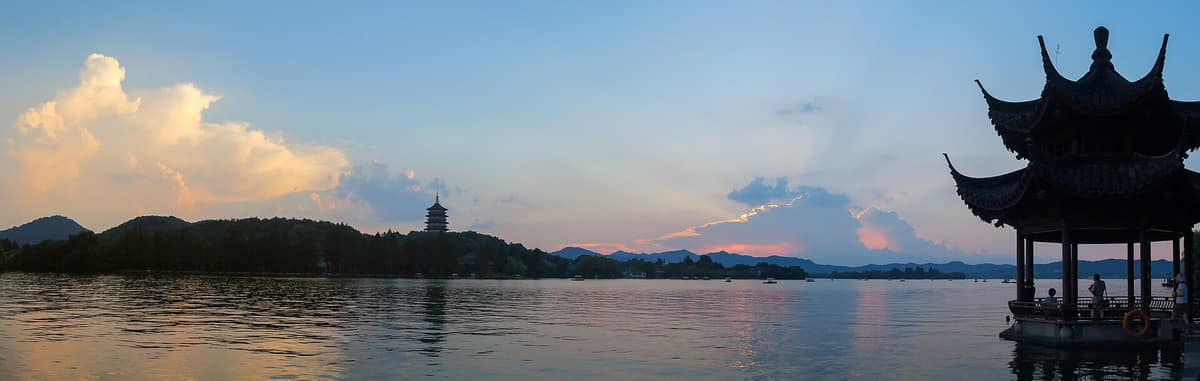
Hills on three sides and the city on the east create a compact cultural landscape of water, paths, gardens, and views.[1][2][3][4][5][6]
A broad tidal river anchors new districts, bridges, flood management, and regional transport.[1][2][3][4][5][6]
The Grand Canal and Xixi Wetland preserve distinct histories of water use, settlement, ecology, and public space.[1][2][3][4][5][6]
Fuyang, Lin'an, Tonglu, Chun'an, and Jiande add mountains, reservoirs, rivers, towns, agriculture, and forests to citywide data.[1][2][3][4][5][6]
Loading current conditions…
Forecast data: Open-MeteoPermanent residents across Hangzhou Municipality
Population figures use the administrative area and source date shown below.[1]Summers are long, hot, humid, and rainy; winters are cool and comparatively drier. Spring and autumn are shorter transition seasons, and typhoons can affect the region.
Climate describes long-term seasonal patterns; live conditions appear separately.[1][2][3][4][5][6]Flowers, new tea growth, rain, and changing temperatures make layers and waterproof footwear useful.[1][2][3][4][5][6]
Heat, humidity, plum rain, thunderstorms, and possible typhoon effects make shade and indoor breaks important.[1][2][3][4][5][6]
Cooling air and lower humidity often support lake, canal, river, and hill walking.[1][2][3][4][5][6]
Cool damp weather, occasional frost, and quieter landscapes produce a different reading of gardens and water.[1][2][3][4][5][6]
Eleven evidence-led layers connect Liangzhu, Wuyue, the Grand Canal, Southern Song Lin'an, West Lake, craft production, modern transport, reservoir transformation and contemporary metropolitan growth without treating reconstruction as original fabric.
Archaeology records a large settlement system with water management, rice cultivation, differentiated burial and jade production. Modern interpretation parks and museums help explain this evidence but are not themselves Neolithic fabric.[7]
Hangzhou served as a Wuyue capital. Hydraulic works, Buddhist institutions and regional patronage shaped a city whose surviving places have also been repeatedly repaired and rebuilt.[5]
Canal connections linked grain, goods, officials, migrants and information. Hangzhou's northern canal corridor must be read through transport, industry, housing and later public-waterfront reuse, not only as a heritage promenade.[8]
Dredging, causeways, public administration and writing reinforced West Lake as both infrastructure and cultural landscape. Later naming and tourism continued to reshape how earlier interventions are remembered.[5]
As the Southern Song capital, Lin'an supported court institutions, dense commerce, publishing, craft, religious communities and extensive food supply. Archaeological remains, reconstructed streets and later city blocks should be distinguished.[13]
After the capital period, Hangzhou remained important through administration, scholarship, craft, trade, pilgrimage and waterways. Continuity did not mean an unchanged street plan, population or built fabric.[8]
Causeways, islands, gardens, temples, inscriptions, vegetation and named views accumulated across many periods. UNESCO recognition concerns the whole cultural landscape and its influence, not one isolated monument.[5]
New transport and industry altered the city and its links to Shanghai and the Yangtze delta. The collapse of the old Leifeng Pagoda in 1924 also became part of modern heritage memory.[13]
The Xin'an River reservoir created today's Qiandao Lake landscape while transforming settlements, livelihoods and mobility. Aerial scenery should be read alongside relocation histories and contemporary county life.[3]
Eight perspectives describe a 12.700-million-resident municipality through language, migration, neighborhood change, production, research, county geography, living institutions and unequal access—without assigning one West Lake personality to everyone.
Hangzhou had 12.700 million permanent residents at the end of 2025 across ten districts, two counties and one county-level city. A lake-centered urban personality cannot represent this whole population.[1][2]
Standard Mandarin is widespread and local Hangzhou speech belongs to the Wu family. Migration, education and county variation produce multilingual households and different accents rather than one uniform voice.[1][2]
Long-established residents, relocated households, students, service workers and new professionals share a city shaped by redevelopment and rising mobility. Tourism streets reveal only a small part of neighborhood life.[1][2]
Cultivation, picking, processing, weaving, cooking, delivery, cleaning and retail make celebrated products possible. Skill, seasonality, pay, safety and traceability belong in the story beside taste and beauty.[1][2]
Universities, laboratories, digital firms, manufacturing, design, finance, logistics and small businesses create different work cultures. The city is not only a headquarters economy or an e-commerce brand.[1][2]
Canal neighborhoods, riverfront districts, tea villages, Lin'an mountain communities, Fuchun settlements and Chun'an reservoir towns have distinct routines, access and environmental pressures.[1][2]
Temples, mosques, churches, ancestral places, museums, schools and community groups remain used by people, not merely observed by visitors. Privacy and site-specific rules matter.[1][2]
Beautiful public space can coexist with crowding, long commutes, high housing costs, disability barriers and uneven county services. Responsible exploration includes these ordinary urban conditions without reducing residents to problems.[1][2]
Fourteen entries move beyond signature dishes to technique, county produce, tea service, freshwater systems, allergens, traceability, labor and safety.
Hangzhou cuisine includes restaurant classics, household dishes, breakfast, snacks, migrant kitchens and county produce. No four signature dishes can represent a municipality of 12.7 million people.[6][1]
A whole fish is cooked to retain texture and finished with a glossy vinegar-based sauce. Species, source, bones, sugar, soy, wheat and timing vary; the name does not guarantee fish came from West Lake.[6][1]
Layered pork belly is braised with seasonings until tender. Recipes differ in soy, wine, sugar and serving size; diners should confirm pork, alcohol, wheat, soy, sodium and dietary restrictions.[6][1]
Prawns and tea leaves are lightly seasoned to emphasize texture and aroma. Shellfish allergy is central, and tea origin, stock, egg, starch and cross-contact should be checked with the kitchen.[6][1]
Noodles with pork, preserved greens and bamboo shoots connect pantry preservation with seasonal ingredients. Wheat, pork, soy, sodium, pickling and stock vary by maker.[6][1]
Chicken is associated with wrapping and slow cooking traditions, but modern restaurant methods differ. Confirm poultry, stuffing, lotus leaf, alcohol, soy, wheat, nuts and food-safety controls.[6][1]
A thin wrapper, fried dough and scallion are pressed on a griddle and served with sauce. Wheat, gluten, oil, soy, sesame, sweetness and the historical story attached to the name should be checked rather than assumed.[6][1]
Soft molded cakes commonly use rice flour and sweet filling. Color, bean paste, sugar, wheat cross-contact, nuts and celebratory meanings vary across makers and periods.[6][1]
Small thumb-shaped pieces of dough are cooked in soup or other preparations. The name describes form, not meat; wheat, egg, broth, soy and toppings require confirmation.[6][1]
Lotus root may be filled with glutinous rice and cooked with sugar and osmanthus. Sweetness, syrup, stuffing, cross-contact and whether honey is used vary.[6][1]
Brewing practice, water, cup size, snacks, service and retail claims shape tea experience. Price and origin labels should be read critically, especially around famous production areas.[6][1]
Fish and aquatic produce connect rivers, reservoirs, aquaculture, markets and restaurants. Species, season, catch or farm origin, cold chain, bones and ecological impact require traceability.[6][1]
Bamboo shoots, tea, nuts, vegetables, preserved foods and river ingredients from Fuyang, Tonglu, Chun'an, Jiande and Lin'an broaden the city table. Place names should not substitute for verified origin.[6][1]
Cooks, farmers, processors, servers, cleaners and couriers support every celebrated dish. Ask about allergens and dietary rules directly; photographs and translations cannot guarantee ingredients or current hygiene status.[6][1]
Move between different water systems and include at least one landscape outside the familiar eastern shore of West Lake.
Four focused guides turn the complete city profile into seasonal, itinerary, and food decisions.
Its meaning comes from the long interaction of water, hills, causeways, gardens, temples, poetry, named scenes, and repeated acts of design.
Read the story