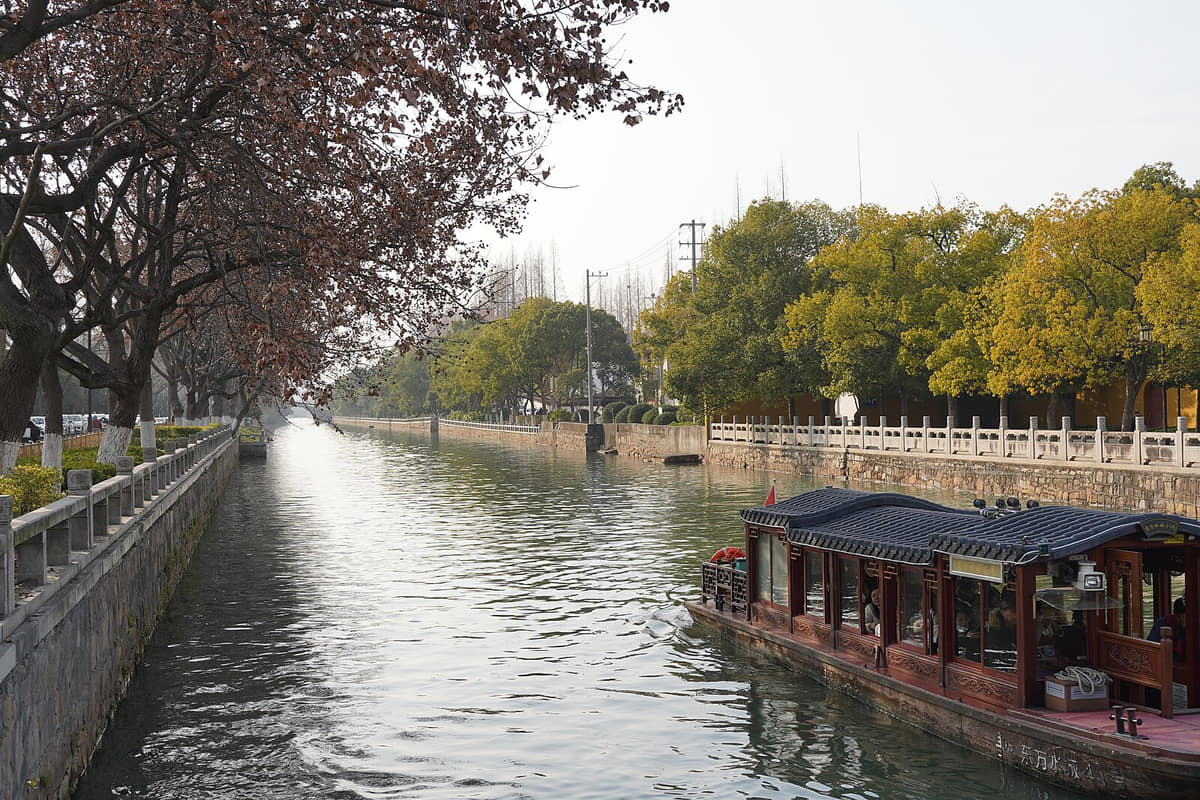
Suzhou is a municipality of several connected landscapes: the canal-lined old city, Taihu-facing districts, the eastern lake-and-industry corridor, Yangtze port towns, and four county-level cities. Treating only the gardens as 'Suzhou' hides most of the place.
Classical gardens and Suzhou components of the Grand Canal
Contemporary scope
Old city, lake districts, manufacturing corridors and Yangtze port towns
Understand Suzhou as a water, craft and production municipality
Suzhou is a municipality of several connected landscapes: the canal-lined old city, Taihu-facing districts, the eastern lake-and-industry corridor, Yangtze port towns, and four county-level cities. Treating only the gardens as 'Suzhou' hides most of the place.
The old city is unusually legible because waterways, lanes, houses, gardens, temples and public institutions still sit close together. Conservation, tourism, residence, drainage, mobility and small business therefore operate in the same limited space.
Suzhou's craft reputation rests on skilled labor and institutions, not decorative labels. Garden making, silk weaving, embroidery, Kunqu, pingtan and collection care each depend on materials, training, rehearsal, documentation and audiences.
Contemporary Suzhou is also a major manufacturing and logistics city. Industrial Park, Kunshan, Taicang, Changshu and Zhangjiagang connect research, factories, housing, migration and port movement; these systems belong in the same city profile as the gardens and canals.
Water systems
Canals, lakes and the Yangtze connect settlement, ecology and movement.
Skilled culture
Gardens, performance, silk and collections depend on labor and institutions.
County-level differences
Four county-level cities extend the story beyond the old core.
Contemporary production
Research, factories, housing and port logistics shape present life.
A visual record of the city
Eighteen rights-cleared visual records move from the old city's canals and gardens to performance, collections, water towns, the eastern contemporary center and Taicang's working port.
Image credits and licenses
Shantang River from a central-Suzhou bridgePhoto: Wikiwakhan · source · CC0
Humble Administrator's GardenPhoto: King of Hearts · source · CC BY-SA 4.0
Suzhou Museum's geometric courtyardsPhoto: Another Believer · source · CC BY-SA 4.0
Pingjiang Road beside the canalPhoto: User:Zhangzhugang · source · CC BY-SA 3.0
Tongli's waterways and housesPhoto: Created by Forrest XYC , photoshopped by FoolPiasar · source · CC BY-SA 4.0
Yunyan Pagoda on Tiger HillPhoto: Chainwit. · source · CC BY 4.0
Container terminal at TaicangPhoto: ---=XEON=--- · source · CC BY 3.0
Location, boundary, and 3D buildings
The map separates the compact old-city core from Taihu-facing districts, the eastern industrial corridor and four county-level cities reaching toward the Yangtze.[1][2][3][4]
Six spatial relationships explain why Suzhou is much larger and more varied than its historic core.
Canal old city
Gusu's dense network of streets and waterways supports drainage, movement, neighborhood life, heritage and tourism at the same time.[1][3][10]
Taihu-facing southwest
Wuzhong and Wujiang connect lake plains, hills, orchards, tea landscapes, towns and expanding urban areas. Conditions differ sharply from the compact historic core.[1][3][10]
Eastern lake and industry corridor
Jinji Lake and Suzhou Industrial Park form a large-scale contemporary center of employment, research, housing, culture and public waterfronts.[1][3][10]
Yangtze north edge
Zhangjiagang, Changshu and Taicang connect river ports, manufacturing, agriculture and county-level urban centers to the wider municipality.[1][3][10]
Water-town network
Tongli, Zhouzhuang and other towns are parts of living district and county systems, not isolated scenery. Housing, schools, services and visitor economies continue around protected fabric.[1][3][10]
Nine county-level units
The interactive map distinguishes five districts and four county-level cities. Municipal population and economy should not be confused with the continuous built-up core.[1][3][10]
Population figures use the administrative area and source date shown below.[1][2][3][4]
Climate
Humid subtropical monsoon climate
Hot, rainy summers and cool, damp winters shape canal neighborhoods, gardens, lake margins, and farming across the municipality.
Climate describes long-term seasonal patterns; live conditions appear separately.[1][2][3][4]
Seasonal patterns
March–May
Spring
Spring in Suzhou can change quickly; rain, wind, pollen, fog, or elevation should be checked before long outdoor routes.[1][2][3][4]
June–August
Summer
Hot, rainy summers and cool, damp winters shape canal neighborhoods, gardens, lake margins, and farming across the municipality.[1][2][3][4]
September–November
Autumn
Autumn often provides clearer intervals and cooler evenings, but current forecasts still matter for coast, mountain, river, and county routes.[1][2][3][4]
December–February
Winter
Winter conditions vary across the municipality; layered clothing and paired indoor–outdoor routes are the safest general approach.[1][2][3][4]
A short history of the city
Ten layers connect water infrastructure, gardens, performance, silk, industrialization and ongoing stewardship without presenting the city as an uninterrupted golden age.
Suzhou Industrial Park across the waterPhoto: 钉钉 · source · CC BY-SA 4.0
Lake-plain foundations
Water, fertile lowlands and regional routes supported long-term settlement before the present urban form. Archaeological evidence should be tied to specific sites rather than a single uninterrupted city story.[1][5][6][7][9][10]
Wu cultural center
Suzhou became an important center in the lower Yangtze region. Later texts, excavated evidence and commemorative landscapes preserve different kinds of memory and should not be treated as identical proof.[1][5][6][7][9][10]
Grand Canal connectivity
The unified canal system strengthened movement of goods, people and administrative resources. Suzhou's waterways were local infrastructure inside a much larger network, not merely picturesque scenery.[1][5][6][7][9][10]
Dense urban water network
Streets, canals, bridges, markets and residential quarters developed into a closely interlocked urban structure. Surviving fragments and later repairs require site-by-site reading.[1][5][6][7][9][10]
Classical garden traditions
UNESCO's nine component gardens document changing approaches to miniature landscape, residence, scholarship, craft and urban life across many centuries—not one fixed style.[1][5][6][7][9][10]
Kunqu and performance
Kunqu developed in Kunshan in the Suzhou region and became an influential theatrical form. Its history continues through performers, teachers, repertory, venues and audiences.[1][5][6][7][9][10]
Silk, craft and commerce
Silk production and related crafts linked rural materials, skilled workshops, urban markets and wider trade. Museum objects and demonstrations illuminate parts of this system but not every worker's experience.[1][5][6][7][9][10]
Industrial and metropolitan expansion
Modern industry, transport, education and housing expanded beyond the historic core. Older waterways and neighborhoods remained important while the municipal economy changed scale.[1][5][6][7][9][10]
Eastern growth and county manufacturing
Suzhou Industrial Park and strong county-level economies reshaped employment, migration, research, housing and regional transport. Contemporary Suzhou cannot be explained as heritage tourism alone.[1][5][6][7][9][10]
World Heritage and active stewardship
The gardens entered the World Heritage List in 1997 and were extended in 2000; the Grand Canal was inscribed in 2014. Listing begins continuing conservation, monitoring and visitor-management work rather than ending it.[1][5][6][7][9][10]
People, language, and everyday rhythms
Seven perspectives describe residents through geography, language, migration, work, performance and access rather than a fixed 'Suzhou personality.'
Municipal scale
The population figure covers five districts and four county-level cities. Residents of the old city, lake districts, industrial corridors, port towns and rural communities do not share one daily routine.[2][3][10][8]
Language and communication
Standard Mandarin is widely used, while local Wu varieties remain part of family, neighborhood and performance life. Language use varies by generation, mobility, workplace and setting.[2][3][10][8]
Migration and work
Manufacturing, research, services, construction and logistics draw people from many places. Migration is central to contemporary Suzhou and should not be treated as an exception to an otherwise static local identity.[2][3][10][8]
Makers and conservators
Garden technicians, textile workers, embroiderers, museum staff, architects and conservators turn cultural reputation into daily skilled labor. Finished objects often hide this work.[2][3][10][8]
Performers and audiences
Kunqu and pingtan continue through training, rehearsal, venues, documentation and listeners. A staged costume image alone cannot show the institutional and social work behind performance.[2][3][10][8]
County-level differences
Kunshan, Taicang, Changshu and Zhangjiagang have distinct industrial, port, agricultural and cultural histories. Their residents should not be described as peripheral to a Gusu-centered story.[2][3][10][8]
Access and visitor pressure
Crowding, ticketing, neighborhood privacy, mobility needs and working hours affect who can use heritage and public space. Current local rules and resident needs take priority over a photographic itinerary.[2][3][10][8]
Culture and daily life
Image credits and licenses
Humble Administrator's GardenPhoto: King of Hearts · source · CC BY-SA 4.0
Master of the Nets GardenPhoto: Chinatravelsavvy · source · CC BY-SA 3.0
Exhibit inside the China Kunqu Opera MuseumPhoto: Ohtashinichiro · source · CC BY-SA 4.0
Historic silk garment in Suzhou MuseumPhoto: M. Kathleen Kern · source · CC BY 2.0
Door fittings at Hanshan TemplePhoto: kevinmcgill from Den Bosch, Netherlands · source · CC BY-SA 2.0
Garden stewardship
Garden culture includes design, planting, water management, rock work, timber repair, documentation and visitor care—not only visual refinement.[5][7][8][9]
Kunqu
Music, text, gesture, costume and sustained training make Kunqu a living performing system. Museum interpretation and stage practice provide different evidence.[5][7][8][9]
Pingtan
Storytelling and ballad singing depend on voice, instruments, repertoire, dialect, venue and attentive listening. Short visitor performances are only one contemporary format.[5][7][8][9]
Silk weaving
Sericulture, fiber preparation, loom knowledge, pattern design, dyeing, finishing and conservation connect rural and urban labor across time.[5][7][8][9]
Suzhou embroidery
Embroidery combines drawing, thread choice, stitch control, time and market judgment. Attribution to documented makers matters more than a generic regional label.[5][7][8][9]
Scholar arts and collections
Painting, calligraphy, books, objects and gardens intersect through collecting and display. Museum custody changes how private objects become public knowledge.[5][7][8][9]
Architecture and repair
White walls, tiled roofs, timber halls and bridges are maintained through repeated intervention. 'Traditional appearance' should never imply that every surface is original.[5][7][8][9]
Temple and community life
Hanshan Temple and other religious places are living institutions as well as heritage settings. Worship, privacy and local access rules require respect.[5][7][8][9]
Water-town routines
Canals organize bridges, deliveries, drainage, housing and visitor movement. Everyday infrastructure is as important as scenic reflection.[5][7][8][9]
Museums and interpretation
Suzhou's museum network separates archaeology, city history, gardens, opera, silk, embroidery and other subjects. Each institution frames evidence differently.[5][7][8][9]
Contemporary design
New museums, waterfronts, campuses and cultural venues adapt regional forms without becoming replicas of the old city. Comparison is more useful than claims of timeless continuity.[5][7][8][9]
Industrial culture
Factory organization, engineering, supply chains, worker communities and technical education are part of contemporary local culture, even when they are less visible to visitors.[5][7][8][9]
Food and local flavor
Thirteen records connect signature dishes with seasonality, county origin, technique, traceability, allergens and live safety checks.
Image credits and licenses
Shantang River from a central-Suzhou bridgePhoto: Wikiwakhan · source · CC0
Tongli's waterways and housesPhoto: Created by Forrest XYC , photoshopped by FoolPiasar · source · CC BY-SA 4.0
Historic silk garment in Suzhou MuseumPhoto: M. Kathleen Kern · source · CC BY 2.0
Suzhou food changes with aquatic produce, tea, fruit, weather and festival calendars. Seasonality is a supply and labor system, not only a menu slogan.[11][12]
Everyday meal
Suzhou soup noodles
Broth, fresh noodles and a separately prepared topping create many combinations. Soup color, noodle firmness, greens and topping are choices that vary by shop.[11][12]
Kunshan tradition
Aozao noodles
The Kunshan noodle tradition belongs inside the municipal story. Broth, fish or duck toppings and present recipes vary, so one branded bowl should not define the whole form.[11][12]
Suzhou cuisine
Squirrel-shaped mandarin fish
Knife work opens the fish before starching, frying and adding a sweet-sour sauce. Restaurant origin stories are not the same as documented recipe history.[11][12]
Taihu hills
Biluochun tea
Tea links Dongshan and Xishan hills, cultivar, picking, processing, grading and brewing. Product labels require origin and season checks; a lake photograph cannot verify either.[11][12]
Lake ingredients
Water shield and whitebait soup
A delicate soup combines aquatic ingredients and egg in many versions. Species, sourcing, season and ecological restrictions need current verification.[11][12]
Origin-sensitive product
Yangcheng Lake crab
Reputation makes traceability essential. Season, legal origin markings, species, size, storage and allergen risk matter more than a generic 'Suzhou crab' claim.[11][12]
Wuzhong tradition
Cangshu mutton
Autumn and winter preparations include soup, braised and sliced forms. Meat source, broth, seasoning and restaurant practice vary.[11][12]
Slow cooking
Braised pork and jiangfang
Pork belly appears in glossy braised preparations and noodle toppings. Sweetness, soy, fat, portion and reheating differ by kitchen.[11][12]
Rice and pastry craft
Suzhou cakes and dumplings
Glutinous rice, flour, bean paste, nuts, sesame and seasonal flowers appear in many forms. Texture and filling are workshop-specific, and allergens require direct checks.[11][12]
Aromatic ingredient
Osmanthus sweets
Osmanthus can scent cakes, sugar, drinks and preserved foods. The label does not prove local flowers, harvest date or a traditional recipe.[11][12]
County food economy
Taicang meat floss and county products
Packaged foods connect local brands, factories, logistics and household use. Check producer, ingredients, storage, certification and actual place of manufacture.[11][12]
Ask precisely
Allergens, dietary needs and live safety
Fish, shellfish, wheat, soy, sesame, nuts, egg, pork stock and shared oil are common possibilities. Vegetarian, vegan, halal and allergy needs require direct questions about ingredients and cross-contact.[11][12]
Landmarks and architecture
Image credits and licenses
Humble Administrator's GardenPhoto: King of Hearts · source · CC BY-SA 4.0
Container terminal at TaicangPhoto: ---=XEON=--- · source · CC BY 3.0
Classical Gardens of Suzhou
A nine-part World Heritage property best read as distinct gardens with different plans, dates and conservation histories—not one interchangeable style.[1][5][6][8][10]
Humble Administrator's Garden
A large water-centered garden whose sequence of views, planting and architecture requires time and movement rather than one photo stop.[1][5][6][8][10]
Lingering Garden
A garden known through spatial compression, varied courts and architectural framing. Current capacity and access should be checked before visiting.[1][5][6][8][10]
Master of the Nets Garden
A compact urban garden where scale depends on carefully arranged water, buildings and viewpoints.[1][5][6][8][10]
Lion Grove Garden
A rockery-centered garden whose close routes can be crowded and visually complex. Stone, repair and circulation need separate explanation.[1][5][6][8][10]
Suzhou Museum
A contemporary public museum joining collections, changing exhibitions and a carefully designed building beside older heritage sites.[1][5][6][8][10]
Pingjiang Road
A canal-side neighborhood where residence, commerce, conservation and tourism overlap. Respect for privacy matters beyond the main lane.[1][5][6][8][10]
Shantang River and street
A historic transport and neighborhood corridor connecting the old city toward Tiger Hill. Boats, bridges and businesses are live operations.[1][5][6][8][10]
Tiger Hill
A wooded hill, pagoda and layered site history. Terrain, structural conservation and visitor circulation matter as much as the silhouette.[1][5][6][8][10]
Panmen
An old-city edge where gate, wall and water-defense narratives meet present reconstruction and visitor landscape.[1][5][6][8][10]
Hanshan Temple
A living Buddhist institution beside the canal, also shaped by literary memory and tourism. Worship and current rules take priority over photography.[1][5][6][8][10]
Grand Canal, Suzhou section
Part of a much larger waterway system. Historic function, current navigation, neighborhood edges and protected components are different subjects.[1][5][6][8][10]
Tongli and Zhouzhuang
Two living water towns in different county-level contexts. Housing, services, transport and visitor economies continue beyond landmark bridges.[1][5][6][8][10]
Jinji Lake and Suzhou Industrial Park
A contemporary eastern center of public waterfronts, culture, offices, research and housing. Events and construction require live checks.[1][5][6][8][10]
Taicang port landscape
A working Yangtze logistics system linking ships, cranes, storage, roads, factories and labor. Public access is limited and operational safety is essential.[1][5][6][8][10]
Ways to explore the city
Four field sequences pair the old city with water towns, the contemporary eastern center and the municipality's production landscape. They are editorial pathways, not commercial itineraries.
Old-city water and gardens
Suzhou Museum → Humble Administrator's Garden → Pingjiang Road
Compare museum interpretation, managed garden space and a living canal neighborhood. Reserve where required and avoid treating residential lanes as open-air sets.[1][5][6][10]
Canal infrastructure
Shantang River → Tiger Hill → Hanshan Temple → Grand Canal edge
Follow water, bridges, hill terrain, worship and transport memory while distinguishing historic fabric from later visitor infrastructure.[1][5][6][10]
Water towns and county life
Tongli in Wujiang or Zhouzhuang in Kunshan
Choose one town and read housing, schools, services, mobility and tourism together. Current transport and opening rules matter more than completing a checklist.[1][5][6][10]
Contemporary production city
Jinji Lake → Suzhou Industrial Park → Taicang port context
Move from public waterfront and research districts toward the municipality's logistics edge. Port areas are working sites; use legal public viewpoints and never enter operational zones without authorization.[1][5][6][10]
Planning collection
Plan a first visit to Suzhou
Four focused guides turn the complete city profile into seasonal, itinerary, and food decisions.
How do water, gardens and industry coexist in Suzhou?
Suzhou's canals are not a decorative preface to a garden city. They are part of a larger municipal system linking old neighborhoods, protected landscapes, county-level manufacturing cities and Yangtze logistics.