
Hangzhou First-Time Guide: What to See and How to Plan
Plan a first visit to Hangzhou with realistic timing, cultural context, priority landmarks, seasonal guidance, and routes that reflect the city's geography.
The short answer
Two full days cover a thoughtful West Lake circuit and a canal or tea-focused second day. Three days allow the city beyond the postcard lake to become visible.
What to prioritize
Hangzhou is not one postcard around West Lake. The municipality extends from a dense lake-and-river metropolis through canal districts and wetlands to Lin'an's mountains, the Fuchun corridor, Chun'an's reservoir landscape and Jiande's towns. A county-level map is therefore essential to understanding its scale. Its history is unusually layered: Liangzhu archaeology, Wuyue state-building, Grand Canal networks, Southern Song Lin'an, cultivated lake scenery, tea and silk systems, industrial and transport change, and a contemporary economy of manufacturing, services, research and digital platforms. Water takes several forms here—composed lake, tidal river, freight canal, wetland, reservoir and working river corridor. Each has different communities, hazards, infrastructure and conservation questions, so the guide avoids collapsing them into one poetic idea of Jiangnan. This guide separates visible evidence from interpretation. Reconstructed towers are distinguished from archaeological remains; museum buildings from collections; dated food photographs from fixed recipes; living religious places from tourist scenery; and climate baselines from current weather.
West Lake Cultural Landscape
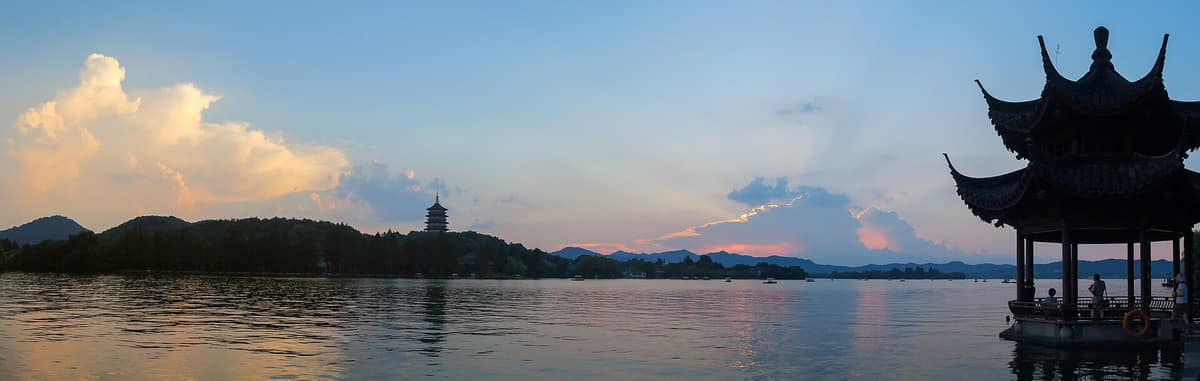
A UNESCO cultural landscape of water, hills, causeways, islands, gardens, temples and named views. Routes should connect visual composition with maintenance, public use and environmental pressure.[5]
Lingyin Temple
A living Buddhist institution in a wooded valley. Architecture, worship, monastic life, conservation, tourism and visitor conduct require separate attention.[5]
Feilai Feng carvings
Rock-carved Buddhist figures near Lingyin. Individual groups differ in date and identity, and the carved landscape is larger than any close photograph.[5]
Leifeng Pagoda site
The current tower is a later reconstruction above archaeological remains; the original tower collapsed in 1924. Archival, archaeological and current architectural evidence must be labeled separately.[13]
Liuhe Pagoda
A historic pagoda above the Qiantang corridor. The tower, wooded setting, river relation, roads and current access form different layers of the visit.[12]
Grand Canal and Gongchen Bridge
A living waterway and major stone crossing in northern Hangzhou. Navigation, industrial history, neighborhoods, conservation and public-space reuse meet here.[8]
Build a realistic first visit
- Choose one coherent West Lake side or loop rather than racing among every named scene.
- Start hill and tea-village walks early, especially in warm weather, and keep rain protection close.
- Use the Grand Canal and its museums to balance the lake-centered image with trade, craft, and neighborhood history.
- Separate scenic West Lake from the much larger contemporary city of universities, offices, housing, and technology districts.
Seasonal orientation
Spring
Flowers, new tea growth, rain, and changing temperatures make layers and waterproof footwear useful.[1][2][3][4][5][6]
Summer
Heat, humidity, plum rain, thunderstorms, and possible typhoon effects make shade and indoor breaks important.[1][2][3][4][5][6]
Autumn
Cooling air and lower humidity often support lake, canal, river, and hill walking.[1][2][3][4][5][6]
Winter
Cool damp weather, occasional frost, and quieter landscapes produce a different reading of gardens and water.[1][2][3][4][5][6]