A multilingual Pearl River metropolis where maritime trade, Cantonese food and performance, craft, migration, urban villages, provincial institutions, ports, manufacturing, services, and mountain-edge districts remain intertwined.
Pearl River port, Cantonese language and food, long-distance trade, Lingnan architecture, museums, manufacturing, services, trade fairs, urban villages, and new CBDs[1][2][3][4]
Guide scope
Eleven districts spanning old river neighborhoods, Zhujiang New Town, urban villages, university areas, manufacturing and port corridors, delta towns, agriculture, and northern mountains[1][2][3][4]
Understand Guangzhou as a river port, neighborhood system, and regional megacity
Guangzhou is best understood as an estuarine metropolis rather than a single skyline. The Pearl River and its channels connect the old Yuexiu–Liwan core, Haizhu and Pazhou, Tianhe's civic and commercial center, eastern port and industrial districts, Panyu's towns and transport hubs, northern mountain landscapes, and Nansha's coastal wetlands. The municipality covers eleven districts; distance, water, topography and development history create substantial variation between them.
Its history is visible in layers that must not be collapsed: Nanyue archaeological remains and objects, long-distance maritime exchange, lineage institutions and craft architecture, religious sites, nineteenth- and twentieth-century waterfront transformation, protected neighborhoods, and a post-1980s multi-center metropolis. Museums, conservation plans and excavated context are stronger evidence than legends or visual resemblance.
Cantonese language, Cantonese opera, Guangdong music, lion dance, Guangcai, Guang embroidery, flower markets, neighborhood storytelling and food practices remain living culture, not frozen exhibits. Mandarin and many other Sinitic varieties and languages are also part of daily metropolitan life. No district, accent, occupation, generation or migration history can stand in for all residents.
The city has a humid subtropical monsoon climate: long hot humid summers, short mild winters, a pronounced rainy season, thunderstorms, high humidity and tropical-cyclone risk. Weather, flooding, heat, transport, venue opening and food safety are live conditions; this page supplies durable context and directs time-sensitive decisions to current official services.
Pearl River port
Channels, ports, markets, bridges, islands, migration, and global trade explain the city's long connections.
Lingnan neighborhood
Arcades, ancestral halls, temples, markets, lanes, urban villages, gardens, and food retain fine-grained life.
Multilingual metropolis
Cantonese, Mandarin, Hakka and other languages reflect families, migration, districts, and work networks.
Regional megacity
Metro, port, airport, manufacturing, services, technology, institutions, and outer districts operate at several scales.
A visual record of the city
Twenty-seven locally hosted, rights-cleared images build Guangzhou from the Pearl River outward: three distinct Nanyue archaeology views, old-city craft and neighborhood fabric, living religious sites, Lingnan garden and town settings in Panyu, Baiyun Mountain, Nansha wetland, contemporary cultural and exhibition infrastructure, regional rail, a historical Whampoa engraving and five specific food contexts. Captions distinguish visible evidence from provenance, reconstruction, living practice and current conditions.
The historic core occupies Pearl River channels in the northern delta; the municipality extends south through Panyu and Nansha toward estuarine ports, east through manufacturing corridors, and north into forested hills and reservoirs.[1][2][3][4]
Baiyun, Conghua, and northern Zengcheng add hills, forests, reservoirs, hot springs, villages, and different microclimates.[1][2][3][4]
Municipal scale
Eleven districts span historic river neighborhoods, new CBDs, manufacturing and port zones, university areas, delta towns, farms, and mountain communities.[1][2][3][4]
Permanent residents across all eleven districts of Guangzhou Municipality; do not mix with the historic core, central built-up area, registered residents, commuters, students, railway or airport passengers, visitors, or wider Pearl River Delta estimates
Population figures use the administrative area and source date shown below.[5][6]
Climate
Humid subtropical monsoon climate
Winters are generally mild, while long hot humid summers bring heavy rain, thunderstorms, and tropical-cyclone risk; spring is often wet and cloudy.
Climate describes long-term seasonal patterns; live conditions appear separately.[7][8]
Seasonal patterns
March–May
Spring
Warm, increasingly humid weather, frequent rain, and low cloud reward breathable layers and flexible indoor-outdoor plans.[1][2][3][4]
June–September
Summer
Long hot humid periods, heavy rain, thunderstorms, and tropical cyclones require shade, hydration, and official alerts.[1][2][3][4]
October–November
Autumn
Drier and somewhat cooler conditions often suit old-neighborhood walks, mountain paths, river routes, and outer-district travel.[1][2][3][4]
December–February
Winter
Generally mild but sometimes damp or suddenly cool; this is a comfortable season for long walks and cross-district exploration.[1][2][3][4]
A short history of the city
Eleven sourced layers move from estuarine geography and Nanyue archaeology through long-distance maritime exchange, Whampoa and the Thirteen Factories system, lineage architecture, nineteenth-century waterfront change, twentieth-century roads and civic buildings, repair and reuse, and the contemporary eleven-district metropolis.
Rivers, tidal channels, alluvial ground, hills and the Pearl River estuary shaped routes, farming, markets, defense and settlement long before the contemporary municipality. Modern embankments and reclaimed land must not be projected backward unchanged.[7][9]
Qin–Han transition
The palace-and-garden site and king's tomb provide excavated evidence for early urban life, court space, technology, exchange and burial practice around Panyu. Site, object, historical text and later museum interpretation are separate evidence types.[10][11]
Archaeological context
Objects such as seals only become historically meaningful through recorded find location, association, inscription, material analysis and conservation. A display photograph is useful for form, not a substitute for the excavation record.[11]
Tang–Song port system
Guangzhou developed as a major node in long-distance maritime routes. Port administration, religious and trading communities, ship movement and imported and exported goods changed over time; 'Maritime Silk Road' is an interpretive frame, not one unchanging route.[12][13]
Ming–Qing commerce
As channels, regulations and trading systems changed, anchorage and customs functions shifted through the river corridor. Historical engravings make exchange imaginable but must be read beside port and customs records rather than as exact photographs.[12][13]
Late imperial built culture
Chen Clan Ancestral Hall concentrates carving, ceramic ridge work, plaster, painting and metalwork supplied by linked workshops across the Pearl River Delta. A named building therefore records both lineage organization and distributed craft labor.[14][9]
Nineteenth century
Nineteenth-century treaties, customs systems, shipping, concessions and commercial institutions altered the waterfront and Shamian. These landscapes should be interpreted with their unequal historical context, later local use and conservation—not as style-only nostalgia.[15][9]
Early twentieth century
Road building, arcaded commercial streets, concrete construction, public halls and new municipal systems reshaped the old city. Enning Road, Yanjiang Road and the 1931 memorial hall reveal different programs and materials rather than one unified style.[16][31]
Twentieth-century change
Buildings, neighborhoods, religious sites and institutions experienced damage, altered uses, demolition, repair and reconstruction. Present appearance must not be described as an untouched survival from a founding date.[9][16]
Late twentieth to twenty-first century
Tianhe, Zhujiang New Town, Pazhou, Panyu transport infrastructure and Nansha added new civic, cultural, exhibition, residential and logistical centers while the old city remained inhabited and adapted.[7][35]
Contemporary Guangzhou
At end-2025 Guangzhou had 19.101 million permanent residents across eleven districts. That municipality-wide figure should never be mixed with the historic core, built-up area, registered population, commuters, visitors or a wider Pearl River Delta urban region.[5][6]
People, language, and everyday rhythms
Eight perspectives describe 19.101 million end-2025 permanent residents with an exact eleven-district boundary, local variation, multilingual life, multiple migration histories, climate-shaped routines, cultural practitioners, regional work systems and an explicit rejection of one Guangzhou personality.
Population scale with a precise boundary
19.101 million means permanent residents across all eleven districts at end-2025, not everyone present on a given day and not only the central city.[5][6]
Eleven distinct local settings
Liwan lanes, Yuexiu institutions, Tianhe towers, Haizhu riverbanks, Panyu towns, northern mountains and Nansha estuary produce different routines, housing, travel times and attachments.[6][7]
Cantonese and metropolitan multilingualism
Guangzhou Cantonese is a major cultural carrier, while Mandarin, Hakka, Teochew and other Sinitic varieties and languages circulate through families, schools, workplaces, markets and media.[21][7]
Migration is not one story
Long-established local families, workers and students from elsewhere in Guangdong and China, overseas links, return migration and international residents create different biographies and degrees of belonging.[5][21]
River, shade and tea routines
Parks, arcades, shaded streets, morning markets, tea houses, riverside walking and late dining are service and climate adaptations, not proof that every resident lives slowly or eats alike.[22][27]
Practitioners keep culture moving
Performers, musicians, craftspeople, cooks, conservators, museum staff, religious communities, neighborhood associations and learners continually adapt inherited practices.[34][18]
A working regional hub
Port, manufacturing, trade fairs, logistics, rail, services, universities, health care, design, technology and informal work create sharply different schedules and economic positions.[35][13]
No single Guangzhou personality
Descriptors such as practical, open, food-loving or commercially minded may capture some narratives, but they are interpretations—not measurable traits shared by nineteen million people.[5][7]
A locally influential Yue variety carrying oral history, performance, humor, commerce and family memory; competence and use vary by generation, neighborhood and situation.[21]
Cantonese opera
A living theatre system of voice, gesture, music, costume, scripts, training, troupes, stages and audiences extending across Guangdong, Hong Kong, Macao and overseas communities.[18][17]
Guangdong music
An instrumental tradition associated with Guangzhou and the Pearl River Delta whose ensemble, repertoire, venues and transmission have changed across amateur, theatrical and professional settings.[19]
Lion dance and Shawan practices
Movement, percussion, martial training, costume making, ritual and community organization meet in southern lion traditions; performance context matters as much as visual spectacle.[20]
Building crafts at Chen Clan Hall
Wood, stone and brick carving, ceramic ridge work, plaster relief, painting and metal casting show coordinated craft networks rather than the work of one anonymous 'traditional style.'[14]
Guangcai porcelain
Overglaze painting joined kiln, pigment, brush, export-market and workshop knowledge; historic overseas demand shaped some designs without fixing one permanent aesthetic.[23]
Guang embroidery
A regional embroidery practice known for dense composition, color and varied stitches, sustained through changing workshops, teachers, materials, markets and exhibition settings.[24]
Lineage and neighborhood institutions
Ancestral halls, guild spaces, temples, clan records and neighborhood associations historically organized education, welfare, ritual, trade and memory in different ways.[9][14]
Flower markets and seasonal public life
Spring flower markets, temple fairs, dragon-boat activity and neighborhood events transform streets and waterways temporarily; dates, routes and scale change every year.[22][34]
Living religious diversity
Buddhist, Daoist, Islamic, Catholic, Protestant and folk-belief sites belong to active communities as well as architectural history. Respectful etiquette and current institutional guidance take priority over sightseeing assumptions.[22][32]
Maritime exchange as cultural process
Ships and goods also moved techniques, words, tastes, religions, images and family connections. Exchange was uneven and regulated, so it should not be reduced to a celebratory slogan.[12][13]
Museums and contemporary production
Archaeology museums, provincial collections, opera institutions, universities, galleries, design, media and performance venues continually reframe Guangzhou rather than merely preserving a finished identity.[33][17]
Food and local flavor
Fourteen entries treat Guangzhou food as a social and technical system rather than a dish checklist: yum cha, rice rolls, noodle shops, roast meats, white-cut chicken, milk desserts, congee, soups, wok heat, aquatic foods, claypot rice, herbal tea and a wider metropolitan table, ending with explicit allergen and menu-safety guidance.
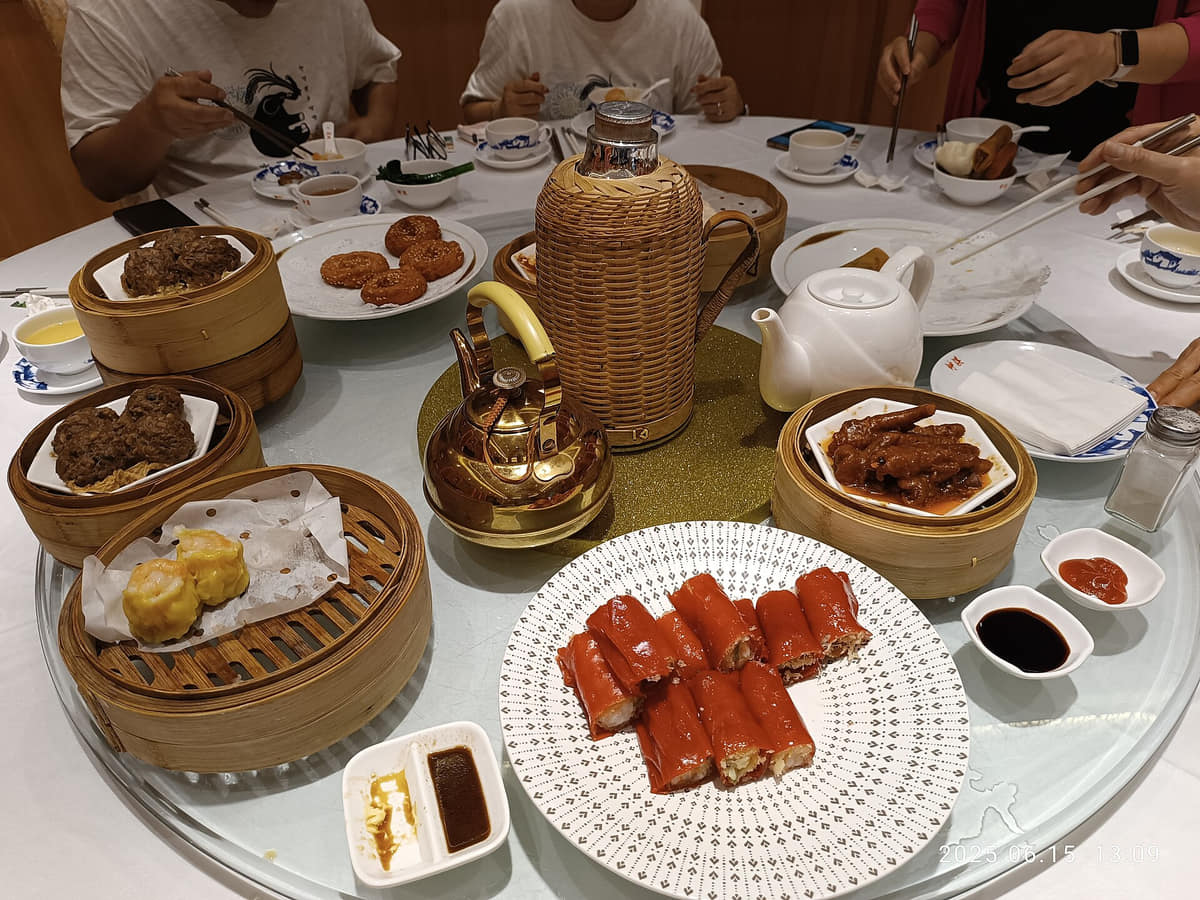
Tea, shared small dishes, ordering, table time and conversation form a service practice; shrimp dumplings, siu mai, buns, steamed ribs and sweets are examples, not a fixed checklist.[27][26]
Steamed rice-batter dish
Rice noodle rolls
Milled rice batter is steamed into thin sheets and served plain or with fillings and sauce; texture, milling, fillings and soy seasoning differ by shop and regional style.[27][28]
Noodle-shop family
Wonton noodles and lo mein
Fine egg noodles may appear in broth or tossed forms with wontons or other toppings; shrimp, pork, wheat, egg and stock ingredients require direct confirmation.[28][27]
Specialist roast-shop practice
Roast meats
Goose, duck, pork and other meats use different marinades, air-drying, roasting, glazing, chopping and sauces. A glossy surface does not establish species, recipe, quality or safety.[26][28]
Temperature-and-texture technique
White-cut chicken
Poaching, resting, chopping and ginger-scallion accompaniments prioritize texture and chicken flavor; doneness conventions vary, while safe handling remains non-negotiable.[26]
Dairy dessert family
Double-skin milk and ginger milk curd
Milk, egg white, sugar or ginger coagulation produce distinct desserts associated with the Pearl River Delta. Dairy and egg allergens, sweetness and serving temperature vary.[28][27]
Rice-based everyday meal
Congee and boat-congee traditions
Long-cooked rice supports changing fish, meat, offal, peanuts, fried dough, scallion and preserved ingredients. A name does not reveal every topping or allergen.[26]
Household and restaurant practice
Slow soups and seasonal broths
Meat, fish, dried goods, roots, legumes and herbs are combined according to household, season and budget; health claims require medical evidence rather than culinary tradition alone.[26]
Heat-management technique
Stir-frying and wok hei
High heat, a prepared wok, small batches, oil, timing and rapid service create aromas described as wok hei. The term is sensory shorthand, not one ingredient or guaranteed quality mark.[26]
Estuary and market supply
Fish and seafood
Freshwater, estuarine, marine and farmed products enter many preparations. Species, sourcing, season, bones, shellfish allergy and sustainability should be checked rather than inferred from a menu photo.[26][28]
Rice crust and topping system
Claypot rice
Rice cooks with cured meat, chicken, eel, ribs, vegetables or other toppings, often forming a browned crust; soy, gluten, fat, bones and cross-contact vary.[28]
Beverage and shop tradition
Herbal tea
Named herbal infusions belong to a protected regional practice, but formulas, bitterness, sugar and contraindications differ. 'Herbal' does not mean suitable for every medication, pregnancy or health condition.[25][34]
Guangfu, Hakka, Teochew and wider circulation
A metropolitan regional table
Guangfu food is prominent, while Hakka, Teochew, Shunde, other Guangdong traditions and cuisines brought by migrants coexist. City availability is not proof of Guangzhou origin.[26][28]
Practical food literacy
Reading menus safely
Ask about shellfish, fish, peanuts, sesame, soy, wheat, egg, dairy, pork, alcohol, herbs, stock, cooking oil and cross-contact. Heritage status, popularity and an attractive photograph never guarantee dietary suitability or current safety.[26][27]
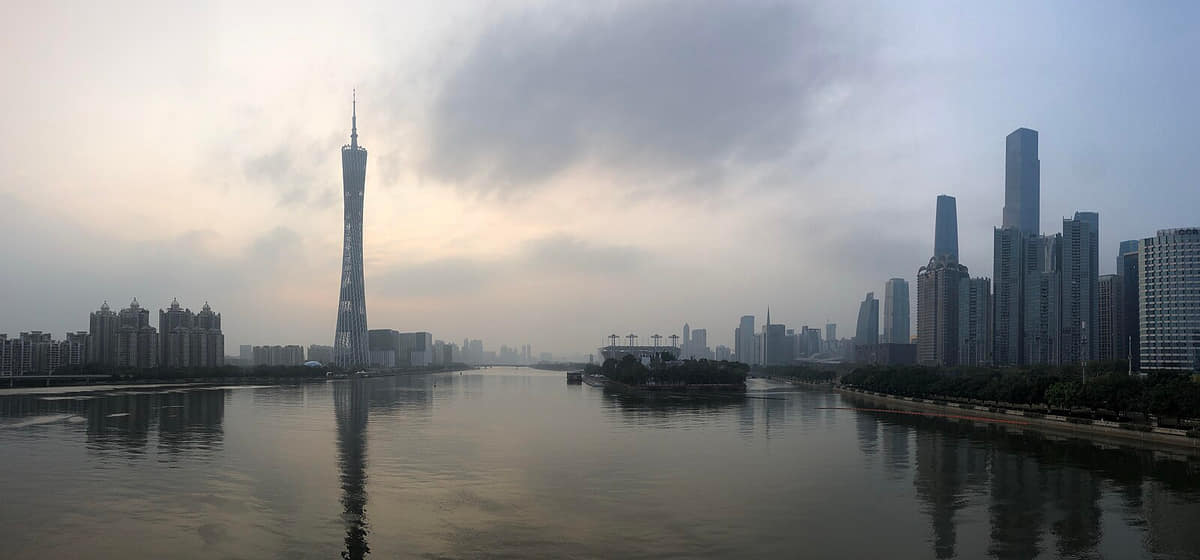
The primary orientation system joining old riverfronts, bridges, islands, embankments, Haizhu, Tianhe and the Canton Tower axis; water and city must be read together.[7][9]
Nanyue King Museum
Two main exhibition areas connect an excavated royal tomb, palace-and-garden remains, objects, conservation and interpretation while preserving their different provenances.[10][11]
Chen Clan Ancestral Hall
A lineage and educational complex whose spatial organization and coordinated decorative crafts reveal institutions, workshops, materials and later conservation.[14]
Enning Road
A lived-in historic district where qilou, concrete-era buildings, lanes, residents, opera associations, repair, commerce and tourism overlap address by address.[16]
Cantonese Opera Art Museum
A purpose-built museum, garden and stage embedded in a neighborhood with continuing opera associations; institution, performance and old-city setting complement rather than replace one another.[17][18]
Shamian and the old riverfront
An island grid and layered waterfront of embankments, parks, religious, diplomatic, customs, commercial and residential buildings requiring building-by-building chronology.[15][9]
Sacred Heart Cathedral
A protected stone cathedral in a living commercial neighborhood; architecture, worship, local community, maintenance and visitor etiquette remain distinct.[32]
Temple of the Six Banyan Trees
A living Buddhist institution centered visually on the Flowery Pagoda, with multiple histories of worship, rebuilding, objects, gardens and neighborhood relation.[22][9]
Sun Yat-sen Memorial Hall
A 1931 large-span civic memorial and performance venue whose Chinese-derived architectural language, modern structure and later maintenance should be read together.[31]
Guangdong Museum and Opera House
Two different cultural institutions in Zhujiang New Town: one province-wide collecting and research museum, the other a performance venue with live programming.[33][7]
Canton Tower and Huacheng Square axis
A contemporary cross-river orientation sequence of tower, open space, civic institutions and skyline; lighting and event spectacle are secondary to spatial reading.[7][8]
Pazhou and Canton Fair Complex
Large exhibition halls, transit, hotels, offices and river edge form an event district whose population and movement change sharply with schedules.[35][7]
Baiyun Mountain
An urban mountain system of protected areas, paths, managed attractions, vegetation, views and neighborhood edges rather than one scenic gate or cable car.[7][9]
Yuyin Shanfang
A compact Panyu garden linking ancestral, educational and residential culture through ponds, pavilions, framed views, shade, later additions and repair.[29]
Shawan historic town
A Panyu townscape connected to Guangdong music, lion dance, lineage institutions, workshops, residences and present-day visitor activity.[19][20]
Nansha Wetland
A managed estuarine wetland of mangroves, reed beds, mudflats, channels, bird habitat, education and tourism where conservation limits matter.[30]
Guangzhou South Railway Station
A Panyu high-speed-rail hub connecting municipal and regional movement; static architecture is durable, but services and passenger conditions are live data.[7][6]
Ways to explore the city
Pair an old river neighborhood with a contemporary center, then choose one outer district to see the full municipal scale.
Old river city
Nanyue King Museum → Yuexiu streets → Chen Clan Hall → Liwan
Connect archaeology, old-city topography, lineage craft, markets, neighborhoods, and food without reducing the area to nostalgia.[1][2][3][4]
Two metropolitan fronts
Shamian → river transit → Zhujiang New Town
Compare nineteenth-century trade architecture and old neighborhoods with contemporary cultural institutions, offices, housing, and skyline.[1][2][3][4]
Core to outer district
Central Guangzhou → Panyu, Nansha, Conghua, or Zengcheng
Choose one outer direction to encounter delta towns, ports, universities, agriculture, mountains, villages, or new industry.[1][2][3][4]
Planning collection
Plan a first visit to Guangzhou
Four focused guides turn the complete city profile into seasonal, itinerary, and food decisions.