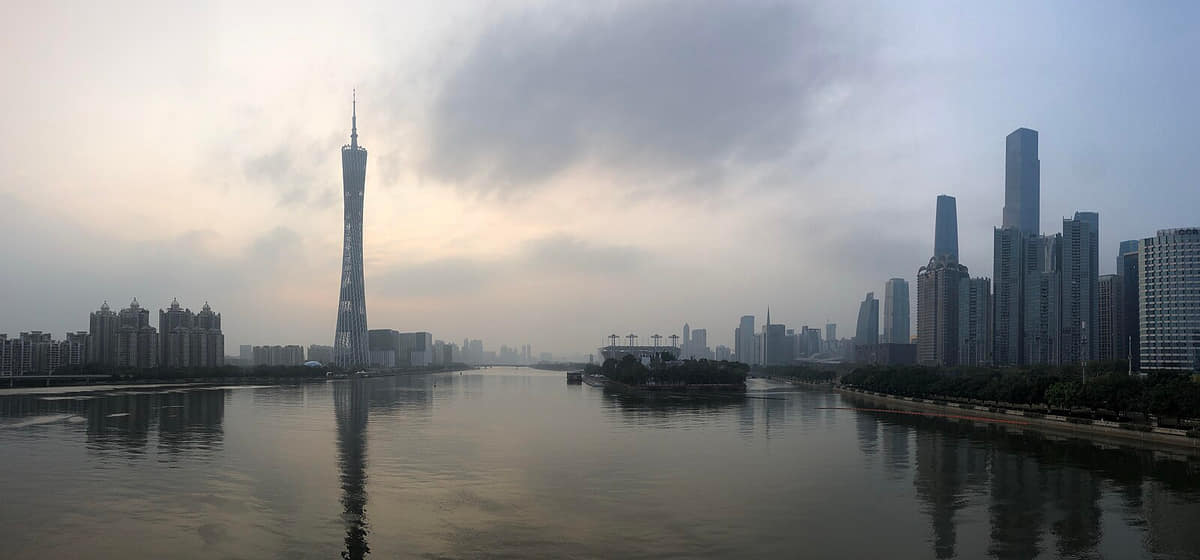
A three-day Guangzhou route can connect maritime and commercial history, Lingnan building traditions, and the markets and dining rhythms of a working southern metropolis.
A culture-first three-day route
Day 1
Old river city
Nanyue King Museum → Yuexiu streets → Chen Clan Hall → Liwan
Connect archaeology, old-city topography, lineage craft, markets, neighborhoods, and food without reducing the area to nostalgia.[1][2][3][4]
Day 2
Two metropolitan fronts
Shamian → river transit → Zhujiang New Town
Compare nineteenth-century trade architecture and old neighborhoods with contemporary cultural institutions, offices, housing, and skyline.[1][2][3][4]
Day 3
Core to outer district
Central Guangzhou → Panyu, Nansha, Conghua, or Zengcheng
Choose one outer direction to encounter delta towns, ports, universities, agriculture, mountains, villages, or new industry.[1][2][3][4]
Keep the pace realistic
Organize days by metro corridor and river crossing; the administrative city is much larger than the traditional center.
Treat morning tea as a meal with pacing and shared ordering, not as a quick tasting stop between attractions.
Use the Nanyue collections, Chen Clan complex, and older streets to distinguish different periods of Lingnan history.
Keep an indoor museum block for high heat, heavy rain, or thunderstorms and move river walks toward the evening.
What to eat along the way
Fourteen entries treat Guangzhou food as a social and technical system rather than a dish checklist: yum cha, rice rolls, noodle shops, roast meats, white-cut chicken, milk desserts, congee, soups, wok heat, aquatic foods, claypot rice, herbal tea and a wider metropolitan table, ending with explicit allergen and menu-safety guidance.
Social meal system
Yum cha and dim sum
Tea, shared small dishes, ordering, table time and conversation form a service practice; shrimp dumplings, siu mai, buns, steamed ribs and sweets are examples, not a fixed checklist.[27][26]
Steamed rice-batter dish
Rice noodle rolls
Milled rice batter is steamed into thin sheets and served plain or with fillings and sauce; texture, milling, fillings and soy seasoning differ by shop and regional style.[27][28]
Noodle-shop family
Wonton noodles and lo mein
Fine egg noodles may appear in broth or tossed forms with wontons or other toppings; shrimp, pork, wheat, egg and stock ingredients require direct confirmation.[28][27]
Specialist roast-shop practice
Roast meats
Goose, duck, pork and other meats use different marinades, air-drying, roasting, glazing, chopping and sauces. A glossy surface does not establish species, recipe, quality or safety.[26][28]
Temperature-and-texture technique
White-cut chicken
Poaching, resting, chopping and ginger-scallion accompaniments prioritize texture and chicken flavor; doneness conventions vary, while safe handling remains non-negotiable.[26]
Dairy dessert family
Double-skin milk and ginger milk curd
Milk, egg white, sugar or ginger coagulation produce distinct desserts associated with the Pearl River Delta. Dairy and egg allergens, sweetness and serving temperature vary.[28][27]
Why Guangzhou belongs in this collection
Guangzhou adds Pearl River trade, Lingnan architecture, Cantonese food, ancestral halls, modern commerce, and subtropical urban life. This guide is a planning layer built from the city’s approved atlas profile rather than a booking or ranking page.