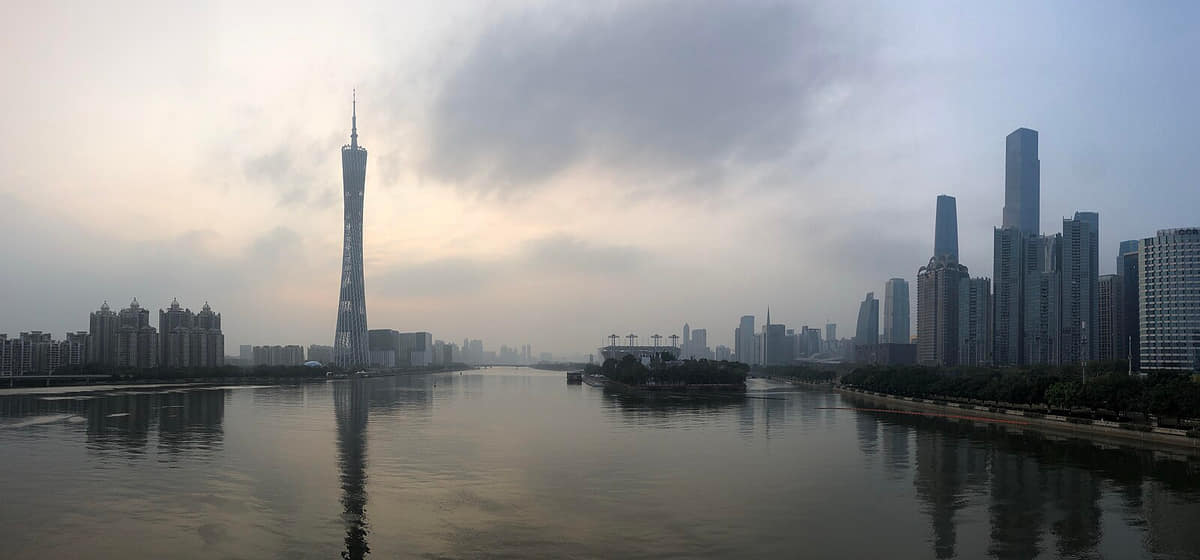
Compare Guangzhou by season, including weather trade-offs, walking conditions, indoor alternatives, and the city experiences that change through the year.
Late autumn through early spring is usually the easiest period for long walks. Spring is humid and rainy, while summer brings sustained heat, thunderstorms, and possible typhoon disruption.
Season by season
March–May
Spring
Warm, increasingly humid weather, frequent rain, and low cloud reward breathable layers and flexible indoor-outdoor plans.[1][2][3][4]
June–September
Summer
Long hot humid periods, heavy rain, thunderstorms, and tropical cyclones require shade, hydration, and official alerts.[1][2][3][4]
October–November
Autumn
Drier and somewhat cooler conditions often suit old-neighborhood walks, mountain paths, river routes, and outer-district travel.[1][2][3][4]
December–February
Winter
Generally mild but sometimes damp or suddenly cool; this is a comfortable season for long walks and cross-district exploration.[1][2][3][4]
How climate changes the plan
Humid subtropical monsoon climate
Winters are generally mild, while long hot humid summers bring heavy rain, thunderstorms, and tropical-cyclone risk; spring is often wet and cloudy.[7][8]
Organize days by metro corridor and river crossing; the administrative city is much larger than the traditional center.
Treat morning tea as a meal with pacing and shared ordering, not as a quick tasting stop between attractions.
Use the Nanyue collections, Chen Clan complex, and older streets to distinguish different periods of Lingnan history.
Keep an indoor museum block for high heat, heavy rain, or thunderstorms and move river walks toward the evening.
Flexible city routes
Old river city
Nanyue King Museum → Yuexiu streets → Chen Clan Hall → Liwan
Connect archaeology, old-city topography, lineage craft, markets, neighborhoods, and food without reducing the area to nostalgia.[1][2][3][4]
Two metropolitan fronts
Shamian → river transit → Zhujiang New Town
Compare nineteenth-century trade architecture and old neighborhoods with contemporary cultural institutions, offices, housing, and skyline.[1][2][3][4]
Core to outer district
Central Guangzhou → Panyu, Nansha, Conghua, or Zengcheng
Choose one outer direction to encounter delta towns, ports, universities, agriculture, mountains, villages, or new industry.[1][2][3][4]
Why Guangzhou belongs in this collection
Guangzhou adds Pearl River trade, Lingnan architecture, Cantonese food, ancestral halls, modern commerce, and subtropical urban life. This guide is a planning layer built from the city’s approved atlas profile rather than a booking or ranking page.