
Beijing First-Time Guide: What to See and How to Plan
Plan a first visit to Beijing with realistic timing, cultural context, priority landmarks, seasonal guidance, and routes that reflect the city's geography.
The short answer
Allow three to four full days for a first visit. Keep the Central Axis, one neighborhood-scale walk, and one outer-municipality landscape as separate experiences instead of forcing them into a single day.
What to prioritize
Beijing is a municipality of 16 districts, not only the historic core. End-of-2025 statistics record 21.800 million permanent residents across dense central districts, expanding plains, new towns and mountain landscapes in the north and west. The most useful way to read the city is as overlapping systems: the Yuan–Ming–Qing urban framework and Central Axis, hutong and courtyard fabrics, water and transport networks, twentieth-century industry and institutions, and twenty-first-century cultural and metropolitan reuse. Heritage is distributed from Zhoukoudian archaeology and mountain Great Wall sections to palaces, ritual landscapes, gardens, canals, tombs, museums and working neighborhoods. Each property has its own boundary, evidence, access rules and conservation issues; one iconic image cannot stand for the whole city. Climate entries describe long-term seasonal patterns rather than live weather. Heat, concentrated summer rain, winter cold, pollen, air conditions, trail safety, venue hours and reservations can change quickly, so operational decisions require current forecasts and official notices.
Forbidden City
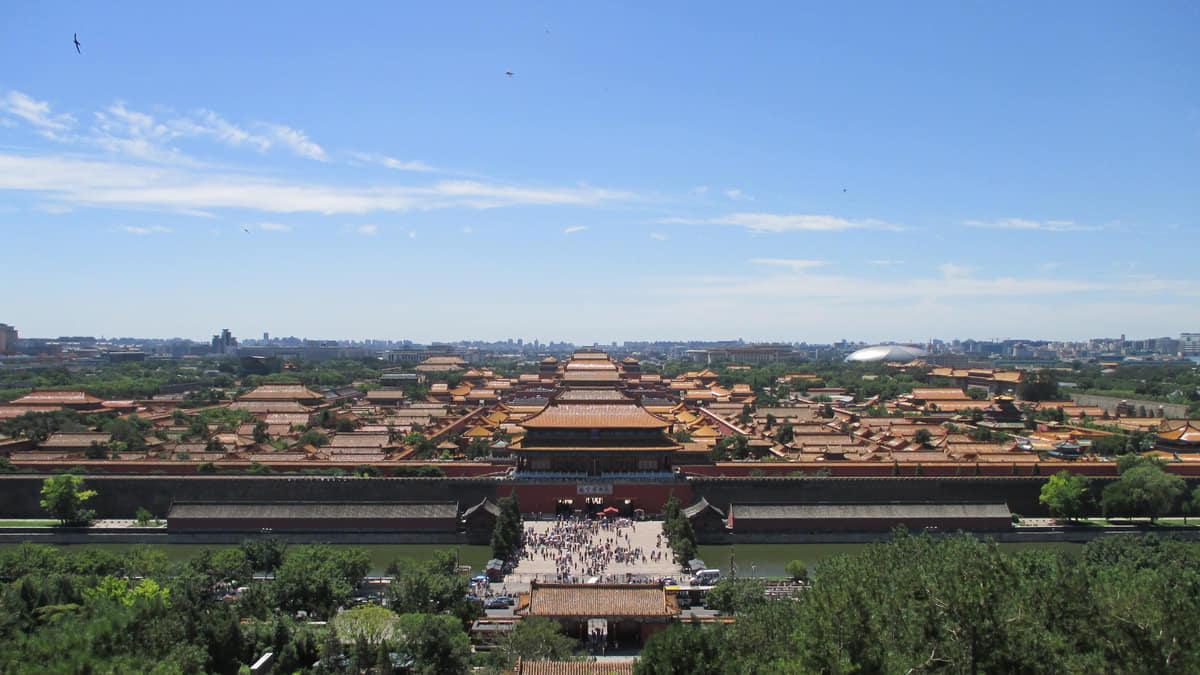
A palace-city complex at the historic center, read through gates, courts, halls, gardens, collections, labor, repair and controlled visitor routes. The panorama shows urban scale, not every component or current condition.[6]
Temple of Heaven
A ritual and landscape complex completed in an early form with the Ming capital. Geometry, color, sound, vegetation, paths and later repair require a site-wide reading beyond the Hall of Prayer close-up.[10]
Beijing Central Axis
A World Heritage property of 15 components extending through the historic city. Its formal order intersects with roads, neighborhoods, tourism, public events, conservation and everyday urban use.[4]
Jingshan
An elevated landscape and public park north of the palace city whose viewpoints help explain roofs and axial order. Stairs, weather, crowding and visibility vary, and the view is not the same as the heritage boundary.[4]
Drum and Bell Towers
Historic timekeeping landmarks at the northern end of the old-city sequence. Architecture, instruments, performance, neighborhood setting and public access should be distinguished rather than reduced to a single tower façade.[4]
Summer Palace
A designed hill-and-lake cultural landscape combining architecture, water, views, movement and layered repair. The broad image records one lake relationship; opening and boat operations are current conditions.[9]
Build a realistic first visit
- Separate large palace or museum visits from long neighborhood walks; security, reservations, and distances can make a packed list unrealistic.
- Use the historic axis to understand sequence and scale, then leave it for hutongs, parks, markets, and specialist collections.
- A Great Wall outing belongs to the municipality but consumes most of a day; choose the section and transport before building the rest of the schedule.
- Opening rules and ticket systems change. Recheck official venue information close to the visit rather than copying an old itinerary.
Seasonal orientation
Spring
Rapid warming, wind, and dry spells make conditions changeable; parks flower while dust and pollen can affect comfort.[1][2][3][4]
Summer
Heat, humidity, and concentrated rainfall shape travel and daily routines; short intense storms are possible.[1][2][3][4]
Autumn
Clearer skies, lower humidity, and cooling temperatures often make this the most comfortable season for long walks.[1][2][3][4]
Winter
Cold, dry weather and indoor heating dominate; daylight and bare tree canopies make historic urban form especially legible.[1][2][3][4]