
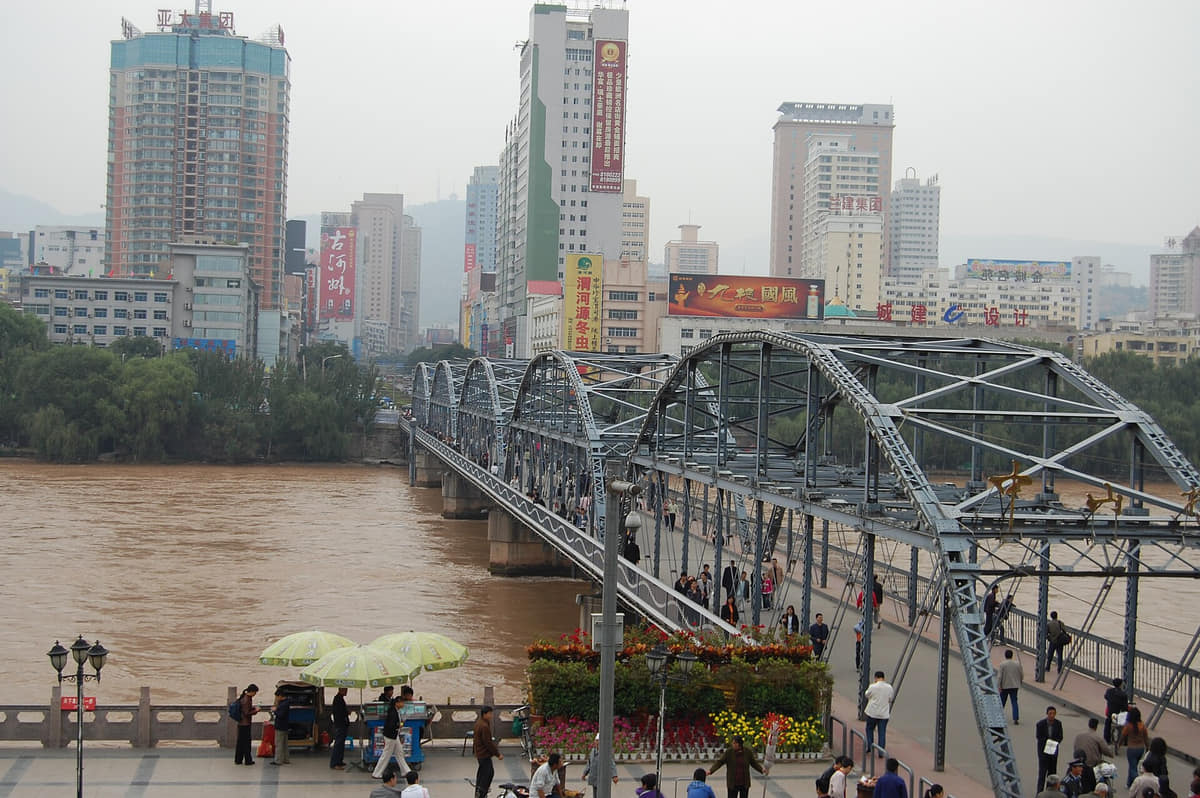
Lanzhou occupies a constrained section of the Yellow River valley. Dry mountains rise close to both banks, leaving a relatively narrow band for settlement, farming, roads, rail, and industry.[1][2][3][4]
As population and institutions grew, the city extended mainly east and west. Bridges linked usable land on both banks, while tunnels, slope work, water supply, flood control, and transit kept the corridor functioning.[1][2][3][4]
Lanzhou's long shape is the visible result of fitting a provincial capital into a narrow Yellow River valley.[1][2][3][4]
The linear form also creates environmental challenges. Inversions, traffic, industrial legacies, scarce water, erosion, and unequal access to open land make river and mountain management part of everyday urban planning.[1][2][3][4]
What does this reveal about Lanzhou?
Geography, infrastructure, industry, ecology, and daily movement are tightly coupled along one east–west urban section.[1][2][3][4]