4 districts, 3 county-level cities, and 5 counties[1][2][3][4]
Interactive map scope
11 locally verifiable county-level areas; see neutral scope note[1][2][3][4]
Population
8.914 million permanent residents (end of 2024, latest verified permanent-resident metric)[1][2][3][4]
Known for
Song–Yuan maritime trade, religious diversity, stone architecture, Dehua porcelain, performance traditions[1][2][3][4]
Guide scope
The old city, coast, county-level cities, inland tea and ceramic areas, and the verified mainland municipal map coverage[1][2][3][4]
Understand Quanzhou through maritime exchange
Quanzhou is best understood as a coastal trading system rather than a single old-city tableau. The historic core, estuary, stone bridges, port markers, ceramic kilns and inland production counties formed connected layers of movement, finance, belief and manufacturing.
UNESCO's 2021 World Heritage property uses 22 component sites to explain Quanzhou as a 10th–14th-century maritime emporium. The nomination is strongest when institutions, transport, religious communities and production hinterland are read together, not as isolated attractions.
The municipality also includes Jinjiang, Shishi, Nan'an, Hui'an, Anxi, Yongchun and Dehua: industrial cities, fishing and port communities, tea hills and ceramic landscapes. County-level differences are part of the city, not optional excursions.
This guide separates visible evidence from interpretation. Living religious places, museum models, reconstructed or protected archaeology, dated markets and working ports have different access, ethics and evidential limits; live weather and opening information must be checked separately.
Ports and routes connected production, trade, administration, and overseas communities.
Living faiths
Religious buildings and rituals reveal coexistence, adaptation, and local continuity.
Craft and production
Ceramics, stonework, textiles, and other crafts linked hinterland and port.
Family and migration
Lineage, diaspora, language, and return journeys continue to shape identity.
A visual record of the city
Twenty-seven locally hosted, rights-cleared records move from the old city to religious places, bridges, port infrastructure, kilns, performance, tea hills and county-level landscapes. Captions identify exactly what is visible and distinguish archaeology, living use, museum models, interpretation and dated scenes.
Image credits and licenses
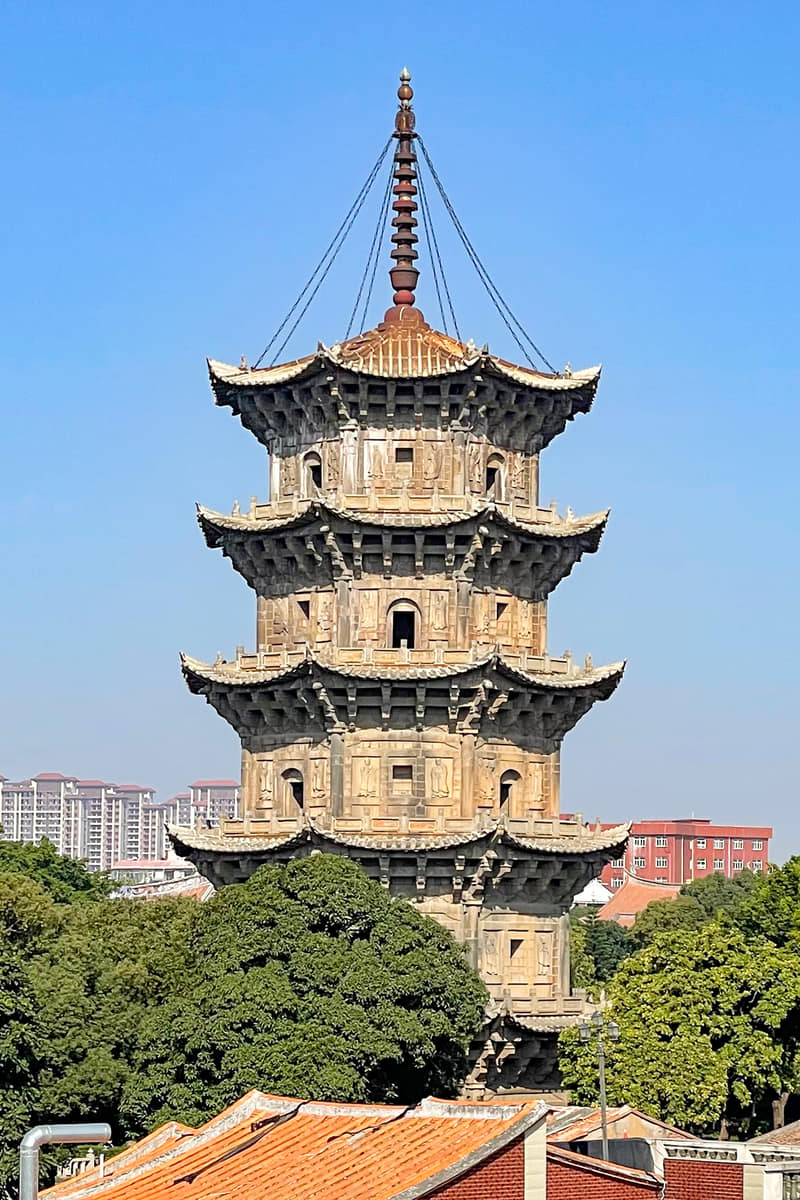
Zhenguo Pagoda at Kaiyuan TemplePhoto: Windmemories · source · CC BY-SA 4.0
West Street and the twin pagodasPhoto: Windmemories · source · CC BY-SA 4.0
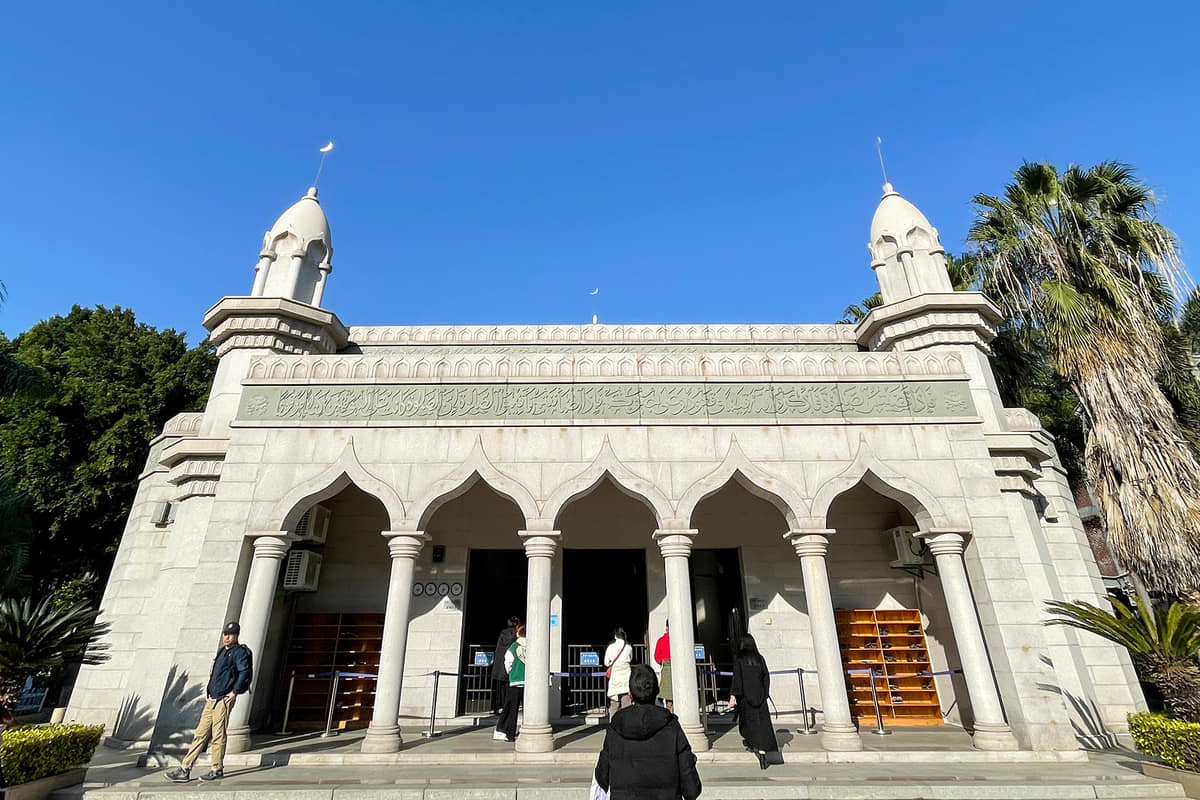
Prayer hall in the Qingjing Mosque precinctPhoto: Windmemories · source · CC BY-SA 4.0
Main hall facade at Tianhou TemplePhoto: Windmemories · source · CC BY-SA 4.0
Protected remains at Deji GatePhoto: Windmemories · source · CC BY-SA 4.0
Quanzhou faces the Taiwan Strait and extends inland through river valleys and hills. The interactive map transparently limits itself to 11 locally verifiable operational geometries and expresses no political position.[1][2][3][4]
Coast, bays, estuaries, low hills, river valleys, and inland mountains explain Quanzhou's ports, settlements, farming, tea, ceramics, and present industrial geography.
Coast and estuaries
Bays, tidal flats, islands, river mouths, and harbors supported maritime movement and still shape fisheries, ports, and urban growth.[1][2][3][4]
Jin River system
River corridors connect inland production and settlements to the coastal plain and historic port zone.[1][2][3][4]
Inland hills
Anxi, Yongchun, and Dehua add tea landscapes, forests, mineral resources, kilns, villages, and mountain transport.[1][2][3][4]
Map scope
The official legal listing has 12 county-level areas; the interactive layer maps 11 with locally verifiable operational geometry and discloses the difference without taking a political position.[1][2][3][4]
Population figures use the administrative area and source date shown below.[2]
Climate
Subtropical maritime monsoon climate
Quanzhou is warm and humid, with hot rainy summers, mild winters, and exposure to typhoons and coastal weather systems.
Climate describes long-term seasonal patterns; live conditions appear separately.[1][2][3][4]
Seasonal patterns
March–May
Spring
Humidity and rainfall rise; old-city walking is possible between showers, while inland hills can be cooler.[1][2][3][4]
June–August
Summer
Heat, humidity, heavy rain, and typhoon risk require flexible plans and attention to official weather warnings.[1][2][3][4]
September–November
Autumn
Lower rainfall and humidity often support coast, bridge, old-city, and inland craft exploration.[1][2][3][4]
December–February
Winter
Winters are mild compared with northern China, though damp wind can feel cool along the coast.[1][2][3][4]
A short history of the city
Eleven evidence-led layers explain the coastal trading system from its earlier settlement base through the Song–Yuan emporium, infrastructure, communities, production, migration, modern industry and World Heritage stewardship.
Image credits and licenses
Protected remains at Deji GatePhoto: Windmemories · source · CC BY-SA 4.0
Ancient-boat model at the Maritime MuseumPhoto: jonjanego · source · CC BY 2.0
Coastal settlement and overland–river links preceded the Song–Yuan peak. Archaeology and topography matter because the later port depended on an already inhabited estuary and routes into Fujian's interior.
UNESCO frames Quanzhou as a major node in Asian maritime trade. Its significance came from a system—city administration, merchants, religious communities, transport and production—not from one monument.
The Maritime Trade Office represents taxation, inspection and institutional coordination. Deji Gate and the southern urban area help place administration beside routes between city, river and harbor.
Kaiyuan Temple, Qingjing Mosque, Lingshan cemetery, Tianhou Temple, Zhenwu Temple and Cao'an record different communities and networks. Their coexistence should be described through documented places, not reduced to a slogan.
Cizao ceramics, Dehua kilns and inland raw materials connected county workshops to overseas demand. Production sites reveal fuel, clay, labor, quality control and transport that finished objects alone conceal.
Routes, regulation and port functions changed after the 14th century. Quanzhou's history continued through regional shipping, craft production and community memory rather than ending when its earlier global role contracted.
Coastal livelihoods, lineage settlements, trade and migration linked Quanzhou communities with Southeast Asia and beyond. Diaspora connections were diverse family and commercial networks, not one uniform identity.
War, political and economic change, migration and new transport reshaped the port city and counties. Historic buildings survived unevenly while production, streets and institutions took new forms.
Late-20th-century private manufacturing and market networks expanded Jinjiang, Shishi, Nan'an and other county-level centers. Footwear, textiles, stone, food and logistics are now essential to understanding the municipality.
The 2021 inscription created a 22-component heritage framework. Conservation now has to work with worship, residence, tourism, infrastructure and industry while keeping archaeology, reconstruction and current use clearly distinguished.
Eight perspectives describe an 8.914-million-resident municipality through language, faith, labor, diaspora, county difference, performance transmission and unequal access without assigning one old-city identity to everyone.
Municipal scale
The 8.914-million end-2024 permanent-resident figure covers the whole municipality, not only the historic core. County-level cities and rural counties contain much of its population and economic life.[2][1]
Languages
Southern Min varieties are important in family, performance and local media, while Standard Mandarin is widely used across education, government and interregional life. Ability and preference vary by generation and community.[2][1]
Living religious communities
Temples, mosques, churches, ancestral halls and cemeteries are not scenic props. Visitors should distinguish public heritage interpretation from worship, burial, privacy and community rules.[2][1]
Production labor
Ceramic workers, tea farmers, textile and footwear workers, stone processors, fishers, port crews, couriers and service staff sustain the city's visible culture and economy.[2][1]
Overseas networks
Family, educational, religious and business ties connect many Quanzhou communities with overseas Chinese societies. These links differ by village, generation, destination and migration history.[2][1]
Coast, city and hills
Daily life differs across the old city, industrial Jinjiang and Shishi, stone-producing Nan'an and Hui'an, tea-growing Anxi, inland Yongchun and ceramic Dehua. One city personality cannot stand for all.[2][1]
Transmission of performance
Nanyin and marionette traditions depend on teachers, clubs, troupes, instrument makers, rehearsal time and audiences. Heritage labels do not replace the labor of continuing transmission.[2][1]
Unequal access and rapid change
Transport, barrier-free access, housing pressure, industrial work schedules and digital information vary across the municipality. Practical guidance should be checked locally rather than inferred from the old-city visitor zone.[2][1]
Culture and daily life
Image credits and licenses
Prayer hall in the Qingjing Mosque precinctPhoto: Windmemories · source · CC BY-SA 4.0
Main hall facade at Tianhou TemplePhoto: Windmemories · source · CC BY-SA 4.0
Two tombs at Lingshan Islamic CemeteryPhoto: User:Vmenkov · source · CC BY-SA 3.0
Quanzhou marionette performance in 2014Photo: S Pakhrin from DC, USA · source · CC BY 2.0
A vocal and instrumental tradition using Quanzhou speech and instruments including the horizontally held nanguan pipa. Its meaning lies in repertoire, ensemble practice and community transmission—not one isolated instrument.[7][8]
Marionette puppetry
Quanzhou marionette performance combines many-string control, carved and costumed figures, music, voice, staging and troupe knowledge. A single performer photograph reveals technique but not the whole theatre.[9]
Local opera stages
Liyuan and Gaojia opera add distinct repertoires, movement systems and performance communities. Programmes and venues change, so current listings should be sourced separately.[1]
Southern Fujian architecture
Red brick, stone carving, timber frames, curved roofs and decorative ceramics appear in temples and houses. Age, repair and reconstruction must be assessed building by building.[5]
Buddhist places
Kaiyuan Temple and its pagodas connect monastic, devotional, architectural and old-city histories. Living worship and heritage visitation should be given equal respect.[4]
Islamic heritage
Qingjing Mosque and Lingshan cemetery document Muslim presence in maritime Quanzhou. Historic evidence and today's community life overlap but are not identical.[4]
Mazu and seafaring ritual
Tianhou Temple links seafaring memory, protection beliefs, architecture and continuing community care. Ritual should be described without turning participants into spectacle.[4]
Daoist landscapes
Zhenwu Temple and the Laozi statue on Qingyuan Mountain show different scales of sacred landscape—from estuary ritual place to monumental mountain carving.[4]
Cao'an and Manichaean evidence
Cao'an preserves unusually specific material evidence associated with Manichaeism. It should not be generalized into a claim about the beliefs of all historical or present Quanzhou residents.[4]
Ceramic knowledge
Cizao and Dehua connect clay selection, kiln construction, firing, workshop organization, trade and collection history. Museum display, working craft and archaeological kiln are different forms of evidence.[5]
Stone engineering
Bridges, pagodas, docks and sculpture demonstrate quarrying, transport, fitting, carving and maintenance. Monumental results should remain connected to materials and skilled labor.[5]
Diaspora and contemporary design
Overseas ties, factory production, sportswear, footwear and digital commerce continue to reshape local aesthetics and identity. Contemporary culture is not merely an afterword to heritage.[1]
Food and local flavor
Fourteen entries connect signature foods with coastal ecology, inland counties, technique, traceability, religious requirements, allergens, labor and current safety checks.
Image credits and licenses
Tea estate in AnxiPhoto: Anxi Yunling Tea Estate · source · CC BY-SA 4.0
Yongchun food-street entrance in 2015Photo: rheins · source · CC BY 3.0
Glutinous rice parcels may contain pork, mushrooms, chestnut or seafood. Recipes, portion size and soy, nut or shellfish exposure need direct confirmation.
Citrus, vinegar and preserved foods connect inland agriculture with household and market use. Product labels should be checked for actual origin and ingredients.
Fish, shellfish and seaweed move through harbors, farms, cold chains and restaurants. Species, origin, season, freshness and ecological impact need traceability.
A city with diverse religious communities requires precise questions about pork, alcohol, halal practice, vegetarian kitchens and cross-contact; neighborhood labels are not guarantees.
Farmers, fishers, processors, cooks, cleaners, servers and couriers sustain every meal. Current hygiene, allergens, prices and opening hours must be verified at the venue.
A living Buddhist compound and old-city anchor. Temple space, stone pagodas, worship, repair and surrounding neighborhoods should be read together.[4][5]
West Street
A working old-city street where housing, food, small business, worship, tourism and views to the pagodas overlap.[4][5]
Qingjing Mosque
A historic mosque precinct containing archaeological fabric and a living prayer space. Different elements and visitor rules must be distinguished.[4][5]
Tianhou Temple
A living temple connecting maritime belief, architecture, ritual and continuing community stewardship.[4][5]
Deji Gate
Protected urban archaeology near the old city's southern edge. Low remains should not be mistaken for a complete gate.[4][5]
Maritime Trade Office site
A key institutional component in the trade system, best understood through archaeology and interpretation rather than a surviving office building.[4][5]
Quanzhou Confucian Temple
A civic and educational ritual complex whose courtyards, halls, repair history and present urban context form distinct layers.[4][5]
Lingshan Islamic Cemetery
A sacred cemetery and historical record of Muslim community presence. Respect, privacy and local access rules take priority over photography.[4][5]
Qingyuan Mountain and Laozi statue
A mountain sacred landscape whose monumental rock carving is only one element among paths, vegetation, inscriptions and living use.[4][5]
Jiuri Mountain inscriptions
An inscribed landscape associated with maritime ritual and official practice. Individual texts require exact on-site identification.[4][5]
Zhenwu Temple
A living religious place at an estuary node. Temple architecture, banyan-covered setting and maritime associations need separate evidence.[4][5]
Cao'an
A hillside site preserving rare material evidence associated with Manichaeism. The exterior setting and interior Mani relief are distinct visual subjects.[4][5]
Luoyang Bridge
A long stone estuary crossing that connects regional roads, tidal conditions, engineering, maintenance and present pedestrian use.[4][5]
Anping Bridge
A major stone bridge whose long linear form linked settlements and movement. Full scale and hydraulic setting require maps and multiple viewpoints.[4][5]
Shihu wharf and estuary docks
Archaeological dock structures coexist with mudflats, fishing, cargo traffic and modern bridges in a working port landscape.[4][5]
Liusheng and Wanshou pagodas
Stone pagodas that helped mark maritime corridors. Their value includes terrain, historic sightlines and port relationships, not only form.[4][5]
Cizao and Dehua kiln landscapes
Production sites and museums connect archaeological kilns, clay, fuel, labor, finished ceramics and overseas circulation across the municipality.[4][5]
Ways to explore the city
Combine the old city with at least one infrastructure, coast, or inland production landscape.
Old-city pluralism
Kaiyuan Temple → West Street → Qingjing Mosque → Tianhou Temple
Walk between living religious places while respecting worship and community use.[1][2][3][4]
Port infrastructure
Old city → Luoyang Bridge → estuary or port landscape
Connect commerce and belief with the engineering and geography that enabled movement.[1][2][3][4]
Inland production
Urban museum context → Anxi tea or Dehua ceramic area
Follow goods from landscape and skilled labor toward trade and global circulation.[1][2][3][4]