Ancient Shu culture, teahouses, Sichuan cuisine, giant panda conservation, and Dujiangyan[7][5][8][6]
Guide scope
The urban core and the wider municipality, including Dujiangyan and western mountain landscapes[1][3][6]
Administrative coverage
12 districts, 5 county-level cities, and 3 counties[2]
Understand Chengdu through sociability and flavor
Chengdu is the capital of Sichuan and the center of a large municipality that stretches from the alluvial Chengdu Plain toward foothills and mountains in the west. Ancient Shu archaeology, irrigation, farming, commerce, migration, and political institutions shaped this geography over long periods.
The modern metropolis is not adequately explained by a relaxed teahouse image. Dense neighborhoods, new districts, universities, technology and service industries, metro lines, greenways, museums, restaurants, county-level cities, and mountain communities all belong to the same municipal system.
Public culture is unusually visible because many activities take place in shared settings: parks, teahouses, markets, food tables, temple courtyards, museum galleries, riverbanks, and neighborhood shops. These spaces are managed, commercialized, and changed as well as enjoyed.
A complete visit therefore moves between evidence types. Archaeological collections explain the deep past; waterworks explain the plain; memorial sites show how later generations construct history; food and performance reveal skilled labor; outer districts restore ecological and county-level scale.
Public rooms for conversation, games, listening, and watching the city.
Sichuan cuisine
Flavor shaped by local ingredients, technique, and shared meals.
Ancient Shu
Archaeology and museums connect the city to distinctive Bronze Age cultures.
Parks and creativity
Public green space, music, design, and neighborhood change share the urban stage.
A visual record of the city
Eighteen rights-cleared documentary views form a visual index of Chengdu: archaeology, hydraulic engineering, memorial architecture, museums, performance, craft, food, public life, conservation, mountain ecology, historic commercial streets, and the contemporary center.
Image credits and licenses
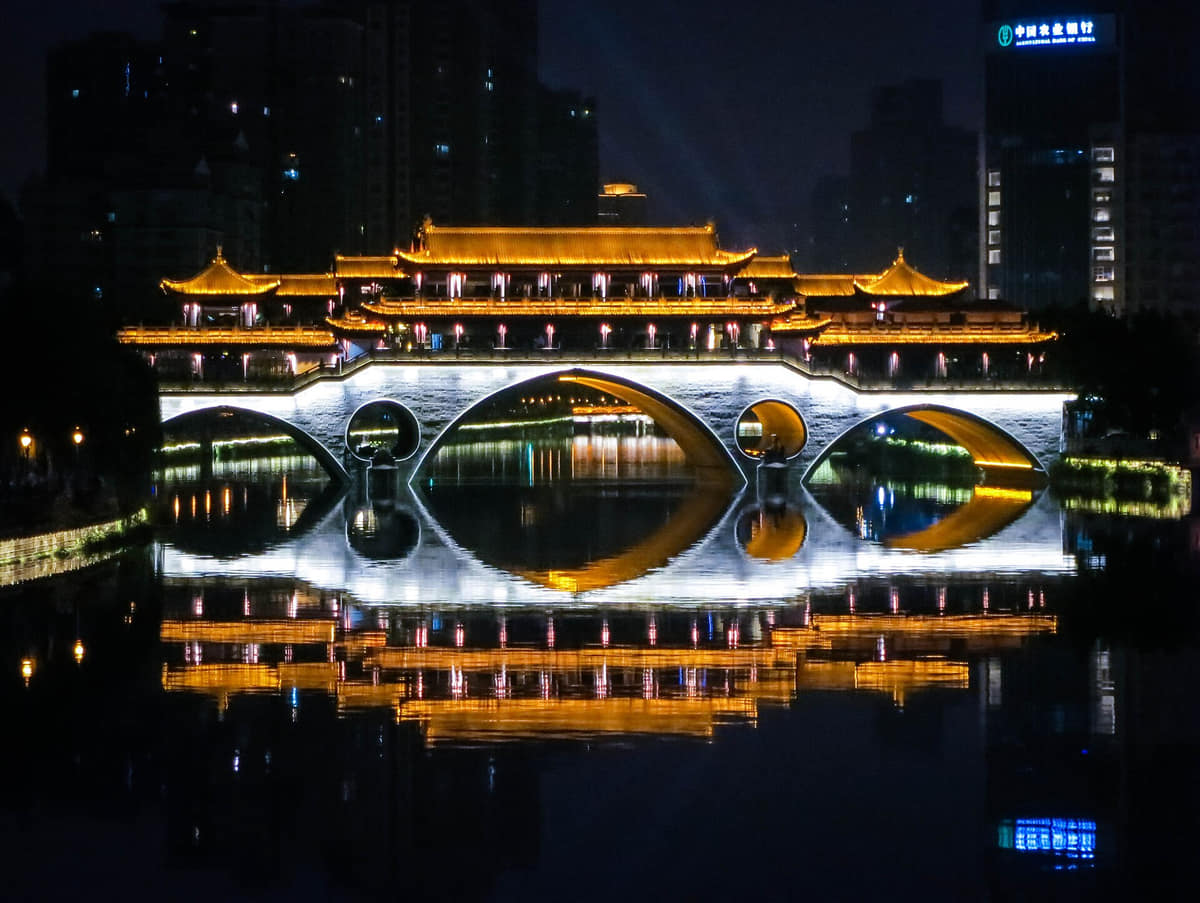
Anshun Bridge and the Jin RiverPhoto: Travel Coffee Book · source · CC0
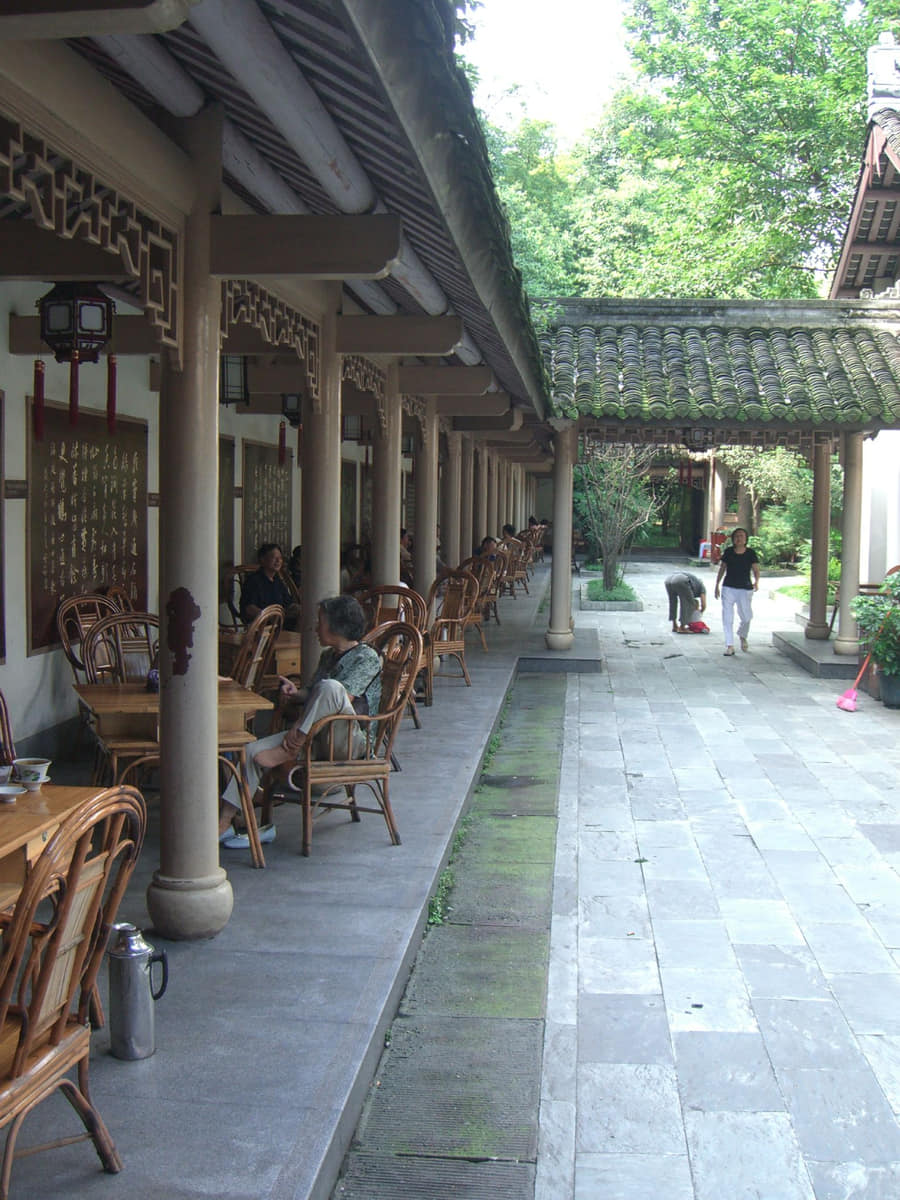
Tea at Du Fu Thatched CottagePhoto: Alpha from Melbourne, Australia · source · CC BY-SA 2.0
The Jinsha excavation hallPhoto: Gary Todd · source · CC0
Dujiangyan on the Chengdu PlainPhoto: JianEn Yu · source · CC BY 2.0
People's Park teahousePhoto: Daderot · source · CC0
Location, boundary, and 3D buildings
Chengdu’s location must be read at three levels: its central reference point, the continuous urban area, and the much larger municipality extending from the plain into western mountains.[1]
Chengdu is not only a dense city center. Its municipality stretches across the Chengdu Plain toward foothills and mountain landscapes in the west, so population, climate, and place descriptions must be read at more than one scale.
The Chengdu Plain
Most of the central and eastern municipality lies on a fertile alluvial plain. Flat terrain supported agriculture, settlement, ring-road expansion, and a broad network of towns.[1][6]
Water as infrastructure
The Dujiangyan system has diverted and distributed Min River water across the plain since the 3rd century BCE. Rivers, canals, wetlands, and greenways still shape the region.[6]
Mountains to the west
The municipality rises toward the Longmen and Qionglai mountain systems. Dujiangyan, Mount Qingcheng, forest habitats, and biodiversity belong to this wider Chengdu landscape.[6][8]
City core and municipality
The statistical municipality includes dense urban districts, suburban new towns, county-level cities, agricultural areas, and mountains. A municipal population is not the same as a compact urban-core count.[3][1]
Population figures use the administrative area and source date shown below.[3]
Climate
Humid subtropical monsoon climate
The Sichuan Basin brings humid air, frequent cloud cover, mild winters, long warm seasons, and rainfall concentrated mainly from late spring through summer.
Climate describes long-term seasonal patterns; live conditions appear separately.[4]
Seasonal patterns
March–May
Spring
Temperatures turn mild, humidity rises, and parks become especially active. Cloudy or showery days remain common, so layers and light rain protection are useful.[1][13]
June–August
Summer
Hot, humid weather and the main rainy season shape the day. Indoor museums, shaded parks, and later evening activity often make more comfortable rhythms.[4]
September–November
Autumn
Early autumn can stay warm, while later weeks are usually milder and less humid. This is often the clearest season for combining urban walks with western day trips.[4]
December–February
Winter
Winters are generally milder than northern China but can feel cool and damp under persistent cloud. Snow is uncommon in the urban core but possible in higher western mountains.[4]
A short history of the city
Nine chronological layers connect ancient Shu material culture, hydraulic engineering, textile production, political memory, poetry, commercial streets, industrial change, museums, and the contemporary metropolitan region.
Image credits and licenses
The Jinsha excavation hallPhoto: Gary Todd · source · CC0
Dujiangyan on the Chengdu PlainPhoto: JianEn Yu · source · CC BY 2.0
A corridor at Wuhou ShrinePhoto: Daderot · source · CC0
Entering Du Fu Thatched CottagePhoto: Daderot · source · CC0
Jinsha and ancient Shu
Jinsha preserves palatial zones, ritual deposits, residential traces, and distinctive gold, bronze, jade, stone, and ivory objects. The site makes clear that Chengdu's urban history did not begin with the surviving imperial-era city.[7]
Qin-era city building and Dujiangyan
Administrative reorganization and the Dujiangyan irrigation system linked political authority with river knowledge, flood management, agriculture, settlement, and the long-term productivity of the Chengdu Plain.[6]
Brocade, workshops, and commerce
Silk and brocade production became closely associated with Chengdu. Loom technology, pattern planning, specialist labor, markets, and long-distance exchange all contributed to the city's craft identity.[11]
A regional metropolis
Population, markets, religious institutions, gardens, printing, poetry, and craft expanded Chengdu's regional importance. Later museum collections help reconstruct everyday and institutional life that no single monument preserves.[11]
Shu Han capital and later commemoration
Chengdu served as the capital of Shu Han. Wuhou Shrine is not a frozen third-century site; it is a later memorial complex whose architecture, inscriptions, ritual, literature, and popular reception developed across many periods.[10]
Du Fu's Chengdu years
Du Fu lived in Chengdu for several years and composed more than two hundred surviving poems there. Today's Thatched Cottage combines reconstructed memory, later buildings, gardens, collections, research, and public literary education.[9]
Streets, guilds, temples, and rebuilding
Repeated rebuilding shaped temples, gardens, city streets, commercial districts, and institutions. Surviving or reconstructed places must be read with their preservation dates rather than treated as untouched remnants.[11][9]
Industry, transport, education, and urban expansion
Rail, roads, factories, universities, public institutions, housing, and migration enlarged the city beyond its older walled core. Neighborhood and industrial histories remain important even when their physical fabric has changed.[1][11]
Archaeology, gastronomy, museums, and metropolitan growth
The discovery of Jinsha in 2001 reshaped public understanding of ancient Shu. UNESCO gastronomy membership, new museums, metro growth, greenways, conservation institutions, and outer-district development continue to reframe Chengdu.[7][5][1]
People, language, and everyday rhythms
The municipal population includes long-established communities and residents from across Sichuan, China, and abroad. Place, language, occupation, age, mobility, and neighborhood matter more than a single city personality.
Language
Standard Mandarin is widely used, while Chengdu speech belongs to Southwestern Mandarin. Pronunciation, vocabulary, code-switching, and humor vary by generation, neighborhood, education, and migration history.[1][3][13]
Public-space routines
Parks, teahouses, markets, greenways, squares, restaurant tables, and community shops support exercise, conversation, games, childcare, performance, and quiet observation at different times of day.[1][3][13]
Growth and migration
Universities, technology, finance, manufacturing, logistics, services, and construction attract residents from many places. Historic local identity and newer metropolitan identities overlap rather than replace each other cleanly.[1][3][13]
Urban and county lives
Central districts, suburban new towns, county-level cities, agricultural areas, and mountain communities have different housing, mobility, work, and service patterns even within one municipal statistic.[1][3][13]
Work behind cultural images
Tea service, cooking, performance, museum care, animal conservation, weaving, maintenance, transport, and tourism depend on skilled labor that postcard descriptions often leave invisible.[1][3][13]
Avoiding stereotypes
Calling Chengdu relaxed can describe a public image or certain uses of leisure space, but it cannot stand in for the varied schedules, pressures, ambitions, and experiences of more than twenty-one million residents.[1][3][13]
Culture and daily life
Image credits and licenses
Backstage at Sichuan operaPhoto: Gary Todd from Xinzheng, China · source · CC0
A Sichuan brocade loomPhoto: Gary Todd from Xinzheng, China · source · CC0
People's Park teahousePhoto: Daderot · source · CC0
Kuanzhai Alley at street levelPhoto: Daderot · source · CC0
Teahouses as public rooms
Tea is only one component. Seating, shade, service, conversation, games, performance, neighborhood familiarity, tourism, and long dwell time determine how a teahouse works.[11][9][10][13]
Sichuan opera as a complete theater
Singing, speech, percussion, gesture, costume, makeup, comedy, puppetry, face-changing, fire effects, rehearsal, and backstage labor belong to a regional performance system rather than a single spectacle.[11][9][10][13]
Shu brocade and embroidery
Looms, pattern drafts, dyed threads, specialist coordination, apprenticeship, museum collections, and contemporary design show why textile heritage is a technical practice as well as a visual motif.[11][9][10][13]
Poetry as public memory
Du Fu's poems, later rebuilding of the Thatched Cottage, calligraphy collections, gardens, education, publishing, and annual cultural programs continually reinterpret a historical residence.[11][9][10][13]
Three Kingdoms remembrance
Wuhou Shrine joins political history, literary tradition, temple architecture, inscriptions, ritual, opera, tourism, and popular storytelling. These layers should be distinguished rather than collapsed.[11][9][10][13]
Ancient Shu interpretation
Jinsha and related museum collections connect excavation context with conservation, exhibition design, scholarship, school education, and contemporary visual identity.[11][9][10][13]
Parks, games, and neighborhood leisure
Mahjong, dancing, exercise, tea, music, family outings, and social clubs are visible in some public spaces, but participation and meaning differ across age groups and communities.[11][9][10][13]
Historic streets under tourism
Kuanzhai Alley and Jinli preserve or reconstruct recognizable spatial forms while also concentrating shops, events, branding, visitors, and crowd management. Heritage and commercialization coexist.[11][9][10][13]
Museums and cultural infrastructure
Chengdu Museum, Jinsha, Du Fu Thatched Cottage, Wuhou Shrine, Sichuan Museum, smaller institutions, libraries, theaters, and galleries provide different ways to document the city.[11][9][10][13]
Contemporary creativity
Music venues, bookstores, animation, games, design, fashion, digital production, public art, and reused industrial spaces add new cultural networks without erasing older ones.[11][9][10][13]
Food and local flavor
Twelve entries treat Chengdu food as a system of ingredients, fermentation, aroma, texture, knife work, heat control, service formats, and social settings—not as a list of dishes that are merely spicy.
Mapo tofu in ChengduPhoto: Alpha from Melbourne, Australia · source · CC BY-SA 2.0
Dan dan noodlesPhoto: Alpha from Melbourne, Australia · source · CC BY-SA 2.0
Shared meal
Sichuan hot pot
Broth, dipping sauce, varied ingredients, timing, table service, and conversation create a meal that unfolds collectively. Chengdu styles belong to a wider Sichuan hot-pot family.[5]
Classic dish
Mapo tofu
Soft tofu, fermented bean paste, chile, Sichuan pepper, aromatics, oil, and careful heat control build fragrance, savoriness, heat, color, and a numbing finish.[5]
Noodles
Dan dan noodles
A small serving associated with mobile-vendor history combines noodles, preserved vegetables, minced topping, chile oil, and a concentrated sauce whose balance varies by shop.[5]
Snack
Zhong dumplings
Thin wrappers and pork filling are dressed without soup in sweetened aromatic soy, chile oil, and garlic, producing a deliberate sweet-savory-hot balance.[5]
Wontons
Long chaoshou
Thin skins and tender filling can be served in clear broth or red oil. Wrapper texture, stock or sauce, and serving temperature matter as much as the filling.[5]
Home-style technique
Twice-cooked pork
Pork is first cooked, then sliced and returned to the wok with fermented bean paste, aromatics, and vegetables. Sequence and control define the dish.[5]
Skewered social meal
Chuan chuan
Skewers allow many ingredients and textures to share seasoned broth or cold dressing, making selection, counting, pacing, and group eating part of the format.[5]
Regional ingredient
Rabbit dishes
Cold-eating rabbit, diced preparations, and other versions show knife work, aromatics, preservation, and regional supply networks; styles differ across Chengdu and Sichuan.[5]
Wheat snack
Sweet-water noodles
Thicker noodles combine chew, aromatic sweet soy, garlic, chile oil, and sesame notes. The dish demonstrates that Chengdu seasoning depends on contrast, not heat alone.[5]
Sweet snack
Lai tangyuan
Glutinous-rice dumplings with a sweet filling provide a soft, warm counterpoint to savory dishes and connect snack shops with festival and family food traditions.[5]
Small plates
Red-oil cold dishes
Chicken, offal, vegetables, tofu products, and other ingredients are sliced and dressed to emphasize aroma, texture, temperature, and controlled chile-and-peppercorn intensity.[5]
Everyday rhythm
Tea and market snacks
Gaiwan tea, seeds, peanuts, pastries, pancakes, noodles, and nearby street foods show how eating is organized by place, time, company, and duration as well as recipes.[5]
A memorial complex where timber architecture, courtyards, inscriptions, ritual, Three Kingdoms history, literature, and later popular memory overlap.[10]
Du Fu Thatched Cottage
A literary museum and garden that combines a reconstructed dwelling tradition, Ming–Qing buildings, poetry collections, research, education, and public leisure.[9]
Jinsha Site Museum
A protected archaeological site and museum that interprets Bronze Age settlement, ritual deposits, objects, conservation methods, and ancient Shu research.[7]
Chengdu Museum
A central civic institution with archaeology, urban history, folk-life, shadow-puppet, puppet, and temporary exhibitions inside a contemporary public building.[11]
Chengdu Panda Base
A conservation and research institution combining breeding, veterinary work, behavioral observation, public education, visitor management, and planted habitat.[8]
Dujiangyan irrigation system
A still-functioning water-management landscape where river topography, engineering, maintenance, farming, settlement, heritage, and tourism must be read together.[6]
Mount Qingcheng
A forested mountain landscape of paths, water, religious sites, biodiversity, villages, and visitor infrastructure within the western municipality.[6]
Anshun Bridge and Jin River
A reconstructed bridge-pavilion and night-time riverfront landmark that provides a clear view of how traditional imagery and contemporary urban space interact.[1]
Kuanzhai Alley
A preserved and reconstructed lane district where courtyards, shops, food, events, visitors, local memory, and commercial pressure share limited space.[1]
Jinli
A highly managed pedestrian commercial street beside Wuhou Shrine, useful for examining night-time tourism, staged historic character, food retail, and crowd movement.[10]
Tianfu Square
A large central public space connected to metro lines, museums, civic institutions, high-rise development, and the city's contemporary north–south axis.[1]
Sichuan Museum
A provincial collection near Huanhua Creek whose archaeology, painting, sculpture, ceramics, textiles, craft, and community galleries place Chengdu within wider Sichuan.[11]
Ways to explore the city
A complete view of Chengdu comes from combining the urban core with at least one wider-municipality landscape. These themes are editorial pathways, not fixed commercial itineraries.
Ancient Shu and living water
Jinsha Site Museum → Dujiangyan
Move from Bronze Age material culture to a water system that still supports the Chengdu Plain. This route explains why archaeology and geography belong in the same city story.[7][6]
Poetry and Three Kingdoms memory
Du Fu Thatched Cottage → Wuhou Shrine
Compare two different forms of remembrance: a poet’s reconstructed garden landscape and a temple complex shaped by historical figures, literature, and later commemoration.[9][10]
Food and public life
Market → neighborhood restaurant → park teahouse
Look beyond famous dishes by observing ingredients, ordering patterns, shared tables, snack formats, and the way a long tea session uses public space.[5][12]
Pandas and western ecology
Chengdu Panda Base → Dujiangyan or Mount Qingcheng
Begin with conservation science, then place giant pandas within the mountain, forest, water, and biodiversity landscapes west of the urban core.[8][6]
Planning collection
Plan a first visit to Chengdu
Four focused guides turn the complete city profile into seasonal, itinerary, and food decisions.