
Kunming First-Time Guide: What to See and How to Plan
Plan a first visit to Kunming with realistic timing, cultural context, priority landmarks, seasonal guidance, and routes that reflect the city's geography.
The short answer
Two days are enough for the basin city and provincial context; three days allow a Stone Forest, wetland, or mountain extension. Kunming works best as both a destination and a careful gateway to wider Yunnan.
What to prioritize
Kunming's core occupies a high basin beside Dianchi, with mountains defining the horizon and elevation moderating seasonal temperatures. The lake's tributaries, wetlands, villages, and restoration projects make water central to the metropolitan story. As Yunnan's capital, Kunming gathers regional communities, languages, food, craft, students, trade, tourism, and institutions. Shilin, Dongchuan, Anning, northern counties, and other outer landscapes show how much the municipality differs from its mild central basin. The municipality is much larger than the mild-climate central basin. Dongchuan's red-earth uplands, Shilin's karst, Anning's industrial and hot-spring landscapes, lake-edge settlements, county towns, farms, and transport corridors require separate treatment. This guide separates visible form from live conditions: lake water quality, flower seasons, mushroom safety, transport schedules, market vendors, heritage access, and weather must be checked at the time of a visit.
Dianchi
A large, pressured lake system where wetlands, water quality, tributaries, villages, urban growth, recreation, and restoration meet.[1][2][3][4][5]
Yunnan Provincial Museum
A starting point for archaeology, art, ecology, trade, languages, communities, conservation, and provincial context.[1][2][3][4][5]
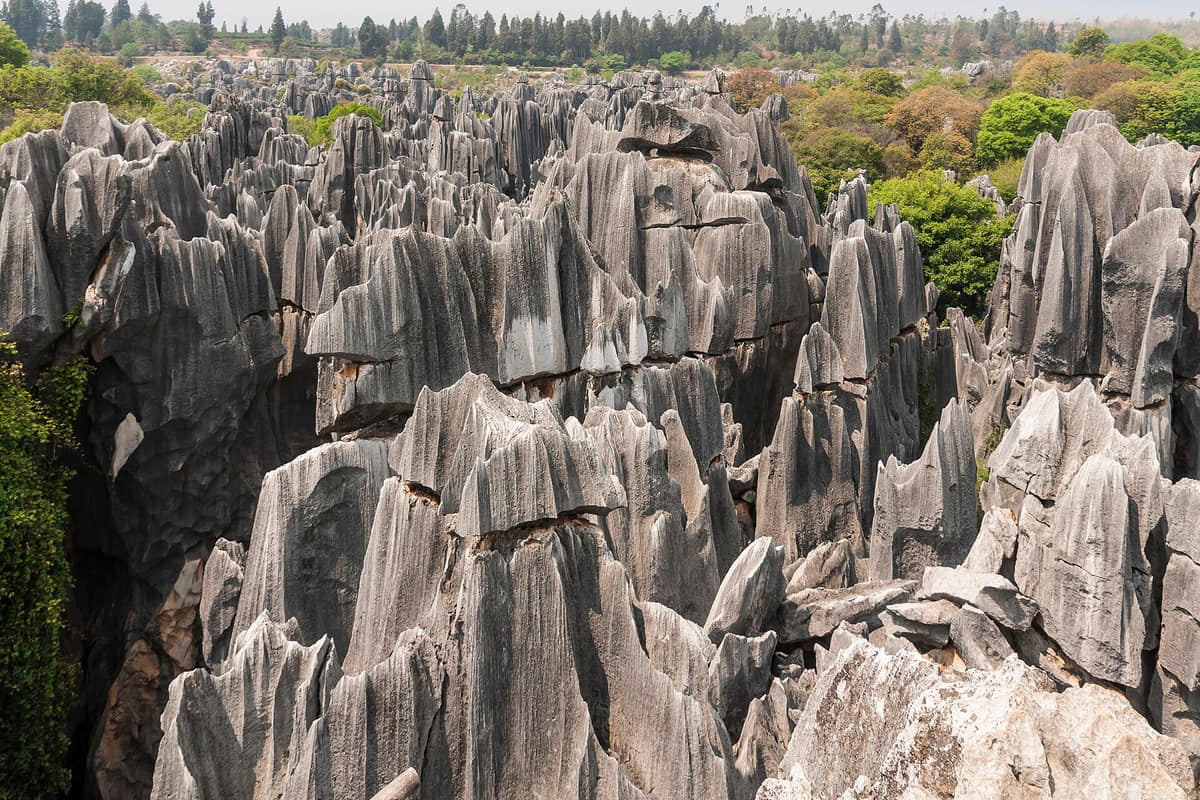
Stone Forest
A county-scale karst landscape requiring attention to geology, Yi community histories, conservation, tourism, towns, and villages.[1][2][3][4][5]
Golden Temple
Bronze architecture, gardens, hill terrain, religious history, repair, recreation, and city views overlap in one complex.[1][2][3][4][5]
West Hills
The mountain edge provides geology, forest, religious sites, paths, villages, lake views, tourism, and ecological pressure.[1][2][3][4][5]
Old city and markets
Rebuilt gates, remaining lanes, temples, shops, food markets, demolition, conservation, and tourism make urban memory contested and active.[1][2][3][4][5]
Build a realistic first visit
- Prepare for strong ultraviolet exposure and large day–night temperature shifts even when daytime temperatures feel mild.
- Treat wild-mushroom identification and complete cooking as safety issues, not as an adventurous dining challenge.
- Use the provincial museum to understand Yunnan’s diversity without presenting many communities as one culture.
- Stone Forest, Dongchuan, and northern counties are separate long excursions; choose one rather than collecting distant names.
Seasonal orientation
Spring
Strong sun, dry periods, flowers, wind, and growing pre-monsoon heat require sun protection and hydration.[1][2][3][4]
Summer
The monsoon brings frequent rain, cooler daytime temperatures than many lowland cities, and storm or landslide risk in mountain areas.[1][2][3][4]
Autumn
Rain retreats, skies often clear, nights cool, and lake, wetland, karst, and county routes become easier to combine.[1][2][3][4]
Winter
Dry sunny days can feel mild, but large day–night temperature ranges, frost, and high ultraviolet exposure matter.[1][2][3][4]