
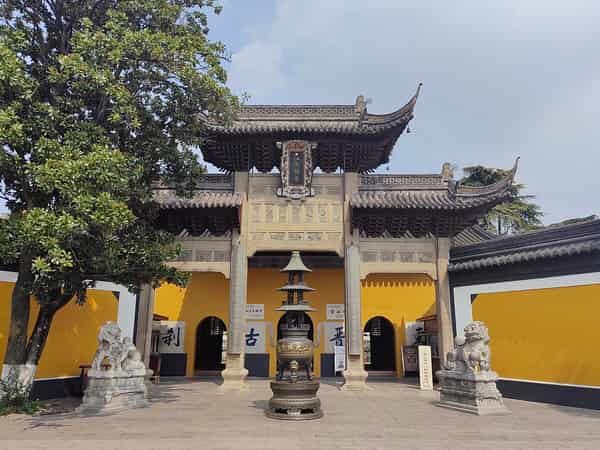
Ferries, temples, markets, military routes, port work, brewing, rail, and modern waterfronts accumulated around the confluence, leaving a city readable through movement and water.[1][2][3][4]
Evidence is distributed across Yangtze River bank, Grand Canal confluence, Jinshan, Jiaoshan, and Beigushan hills, River plain and county-level towns, as well as museums, working neighborhoods, district and county routes, and local collections.[1][2][3][4]
Zhenjiang is best understood as connected systems rather than a single attraction.[1][2][3][4]
The account distinguishes documented facts from interpretation, avoids political positioning and fixed community stereotypes, and leaves room for different residents' experiences.[1][2][3][4]
What does this reveal about Zhenjiang?
Zhenjiang is a river-and-hill city at the Yangtze–Grand Canal junction, where temple mountains, Xijin Ferry, vinegar brewing, port work, historic streets, and county-level towns form a compact system.[1][2][3][4]