Sichuan Province · Sichuan Province, Southwest China
A southern Sichuan city where brine wells, salt engineering, dinosaur strata, river-valley industry, lantern craft, and county agriculture form one unusually legible identity.
Complete municipal coverage across 4 districts and 2 counties[1][2][3][4]
Understand Zigong through connected city and county landscapes
Zigong is a hilly southern Sichuan municipality whose name joins Ziliujing and Gongjing, two salt-producing settlements. Wells, natural-gas use, boiling houses, workshops, guild halls, river transport, labor communities, and markets produced a dispersed urban form along the Fuxi River rather than one simple monumental center.
Its identity also reaches far beyond salt. Middle Jurassic strata at Dashanpu support an in-situ fossil museum and continuing research; lantern production connects seasonal festival practice with drawing, structural fabrication, lighting, mechanics, logistics, and an international workshop economy.
The municipality includes four districts and two counties. Rong County and Fushun County add cliff sculpture, temples, long county histories, farming, market towns, food traditions, and everyday mobility that cannot be represented by the central salt districts alone.
A complete exploration follows systems rather than slogans: geology before dinosaurs, brine and fuel before salt, labor and trade before guild-hall architecture, fabrication before lantern spectacle, ingredients and technique before dish names, and county landscapes before a single city-center image.
Land and water
This city-specific topic connects place, daily life, and the wider municipal landscape: Land and water.
Historical layers
This city-specific topic connects place, daily life, and the wider municipal landscape: Historical layers.
Living culture
This city-specific topic connects place, daily life, and the wider municipal landscape: Living culture.
County diversity
This city-specific topic connects place, daily life, and the wider municipal landscape: County diversity.
A visual record of the city
Eighteen rights-cleared documentary images and clearly labeled regional food references connect Zigong's salt engineering, guild architecture, Jurassic fossil bed, lantern making, river landscape, county heritage, contemporary mobility, and cuisine.
Image credits and licenses
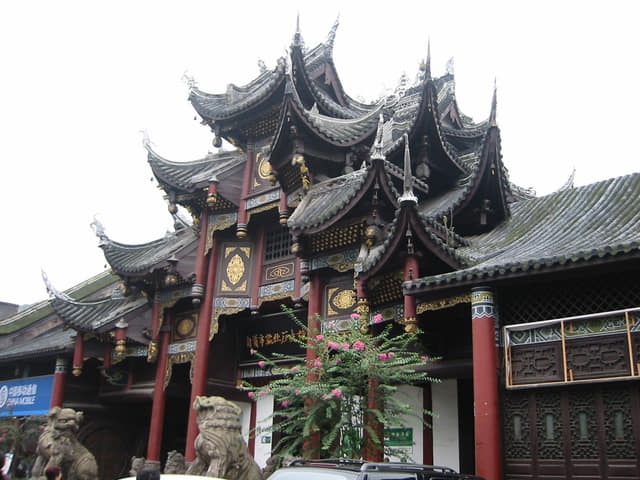
Salt History Museum and Xiqin Guild HallPhoto: Phreakster 1998 at English Wikipedia · source · Public domain
Population figures use the administrative area and source date shown below.[1][2][3][4]
Climate
Humid subtropical monsoon climate
Hot, humid summers and mild, damp winters; basin hills and river valleys shape local heat and rainfall.
Climate describes long-term seasonal patterns; live conditions appear separately.[1][2][3][4]
Seasonal patterns
March–May
Spring
Temperatures rise quickly; rain, cloud, and local elevation call for flexible outdoor plans in Zigong.[1][2][3][4]
June–August
Summer
Hot, humid summers and mild, damp winters; basin hills and river valleys shape local heat and rainfall.[1][2][3][4]
September–November
Autumn
Clearer intervals and cooler evenings usually favor river, old-town, museum, and county routes.[1][2][3][4]
December–February
Winter
Damp cool conditions make layered clothing and indoor–outdoor route pairing practical.[1][2][3][4]
A short history of the city
Nine layers move from Middle Jurassic geology to deep-well engineering, a city formed around salt, museums, lantern heritage, paleontological research, transport, and contemporary conservation.
Surface structure above the wellPhoto: Zhangzhugang · source · CC BY-SA 3.0
The protected fossil bedPhoto: Phreakster 1998 at English Wikipedia · source · CC BY 2.5
Salt History Museum and Xiqin Guild HallPhoto: Phreakster 1998 at English Wikipedia · source · Public domain
The Dashanpu fossil assemblage
Sediments preserved densely associated dinosaurs and other vertebrates in the Middle Jurassic landscape. Their later excavation made geology and paleontology a second foundational archive for the municipality.[9][8]
From brine sources to small-bore wells
Heritage records trace well-salt work across nearly two millennia. Drilling, casing, percussion tools, rope, brine lifting, fuel, and repeated repair developed as connected knowledge rather than one invention.[7][14]
Mature deep-well salt production
Small-bore deep drilling expanded, salt fields attracted capital and workers, and production linked wells with boiling houses, gas, timber rigs, pack routes, waterways, workshops, contracts, and specialist occupations.[7][6]
Shenhai Well and the kilometre threshold
Shenhai Well crossed the one-kilometre threshold using preindustrial drilling methods. Its importance lies in the whole surviving process—drilling, lifting, gas use, brine concentration, boiling, maintenance, and labor.[7][5]
A city established around wartime salt supply
Zigong was formally established in 1939 from the Ziliujing and Gongjing salt districts. Wartime demand enlarged production and transport while air raids, labor pressure, fuel, and logistics shaped urban memory.[12][13]
Salt history becomes museum work
The Salt History Museum was established in Xiqin Guild Hall. Collections, field records, tools, photographs, industrial sites, conservation, publication, and public exhibitions turned production memory into a research institution.[6]
The modern lantern festival and craft economy
A modern city-organized lantern festival began in the 1960s, while older New Year lighting practices supplied cultural roots. Later recognition, museum collecting, technical innovation, and traveling commissions widened the craft network.[10][11]
Excavation and an in-situ dinosaur museum
Large-scale work at Dashanpu exposed a concentrated Middle Jurassic fossil bed. Zigong Dinosaur Museum opened in 1987, combining original strata, mounted specimens, collections, laboratories, and public education.[8][9]
Heritage, industry, rail, and county connections
Geopark management, museum expansion, lantern manufacturing, chemical and equipment industries, river improvement, new rail links, tourism, and county-town change now overlap. Preservation and development remain negotiated rather than automatic.[5][12][1]
People, language, and everyday rhythms
Residents are best understood through language, work, migration, district and county settings, craft networks, and changing mobility—not a single personality assigned to the whole city.
Language
Standard Mandarin is widely used, while local speech belongs to Southwestern Mandarin. Vocabulary, rhythm, occupational terms, and code-switching vary by generation, education, neighborhood, and county.[14][3][2]
Salt-field labor histories
Drillers, rope workers, brine lifters, boil-house crews, carpenters, transport workers, merchants, cooks, and families occupied unequal positions. Celebrating engineering should not erase danger, physical effort, or hierarchy.[14][3][2]
Migration and guild networks
Salt commerce drew merchants and workers from several regions. Guild halls materialized origin networks, finance, worship, dispute resolution, performance, and mutual support while also displaying economic power.[14][3][2]
District and county lives
Ziliujing, Gongjing, Da'an, Yantan, Rong County, and Fushun County differ in density, work, agriculture, commuting, services, dialect detail, and historic centers. One municipal statistic contains many daily geographies.[14][3][2]
Lantern makers and mobile workshops
Designers, metalworkers, binders, surface artists, electricians, mechanics, installers, project managers, and maintenance teams collaborate. Many projects travel, making temporary work sites part of local livelihood.[14][3][2]
Contemporary mobility without stereotypes
Students, factory workers, public-service staff, entrepreneurs, farmers, migrants, retirees, and tourism workers follow different schedules and pressures. A food-loving or inventive city image may be useful branding, but it is not a description of every resident.[14][3][2]
Culture and daily life
Image credits and licenses
A Zigong lantern installationPhoto: Yosomono from Fukuoka, Japan · source · CC BY 2.0
Wangye Temple by the Fuxi RiverPhoto: Zhangzhugang · source · CC BY-SA 4.0
A gallery of mounted skeletonsPhoto: Phreakster 1998 at English Wikipedia · source · CC BY 2.5
Deep-well salt craft
Percussion drilling, bore maintenance, bamboo and timber components, rope systems, brine lifting, gas use, concentration, boiling, and troubleshooting form an integrated technical heritage.[7]
Guild halls as social infrastructure
Xiqin Guild Hall, Wangye Temple, and related sites connect migrant commerce with architecture, worship, contracts, meetings, charitable functions, opera, and the public display of merchant power.[6][14]
Lantern making as fabrication
A lantern begins with design and engineering, then passes through armature work, binding, covering, painting, electrical systems, movement, installation, weatherproofing, testing, repair, and dismantling.[10][11]
The festival as changing public culture
New Year lighting customs, city-organized festivals, ticketed parks, museum collections, sponsorship, digital control, tourism, and commissions abroad belong to different periods and should not be collapsed into one timeless tradition.[10]
Paleontology as active science
Excavation context, specimen preparation, taxonomy, comparative anatomy, stratigraphy, conservation, publication, exhibition, and school programs show that dinosaurs are research material, not only mascots.[8][9]
A geopark across natural and cultural sites
Dinosaur strata, salt geology, wells, river corridors, plant refuges, museums, and communities are managed as a connected landscape. Education and conservation depend on local institutions and residents.[5]
Opera, stages, and occupational associations
Guild and temple architecture included performance space. Sichuan opera, percussion, festival programs, community audiences, and the economics of hosting a troupe linked work organizations with entertainment.[14][6]
Fuxi River memory
Navigation, salt shipment, fuel, warehouses, bridges, temples, flood control, housing, parks, and ecological repair give the river several meanings beyond scenery.[14]
County institutions and local continuity
Fushun's Confucian Temple and historic town fabric, Rong County's cliff sculpture and old civic sites, markets, schools, and villages add cultural systems that are not satellite versions of central Zigong.[3][5]
Industrial and wartime memory
Salt production, chemical industry, transport, air-raid history, worker neighborhoods, machinery, archives, and reused sites require careful documentation. Commemoration should distinguish evidence, later interpretation, and present-day identity.[12][13]
Food and local flavor
Twelve entries explain salt-guild cuisine through flavor construction, labor history, rabbit dishes, Fushun douhua, beef techniques, seasonal aromatics, fermentation, serving format, and the differences between home, market, and banquet cooking.
The term covers foods shaped by salt-field labor, merchant households, restaurants, markets, county ingredients, migration, and changing prosperity. It is diverse, not one fixed menu or a synonym for extreme heat.[14]
Make-ahead rabbit dish
Cold-eating rabbit
Small bone-in pieces are cooked with oil, dried chile, Sichuan pepper, aromatics, and seasoning, then rested. Cooling and standing time allow flavor to settle; texture and spice balance vary by maker.[14]
Cooked-to-order format
Fresh-pot rabbit
Tender rabbit pieces are served in a hot, aromatic mixture often built around fresh chile and young ginger. Knife work, brief cooking, heat control, and immediate serving distinguish it from cold-eating rabbit.[14]
County food tradition
Fushun douhua
Soft soybean curd is eaten with rice and a concentrated dipping sauce. Curd texture, water, coagulant, scooping, sauce composition, and serving temperature are all part of the experience.[15][16]
Flavor concentrate
Douhua dipping sauce
Chile, oil, fermented or preserved components, aromatics, sesame, and other seasonings can be adjusted by producer. A local technical standard records the sauce as a place-linked product rather than a generic condiment.[16]
Poaching and hot-oil technique
Shuizhu beef
Thin meat, vegetables, seasoned liquid, chile, peppercorn, and a hot aromatic finish create tenderness, fragrance, heat, and numbing sensation. Later Sichuan versions should not obscure the dish's strong Zigong association.[14]
Thin dried beef
Huobianzi beef
Beef is cut or stretched into thin sheets, seasoned, dried, and finished to concentrate aroma and chew. The name is commonly rendered in English as fire-edge or fire-whip beef; preparation varies among workshops.[14]
Town-linked braise
Niufu braised pork knuckle
Associated with Niufu in Da'an District, pork knuckle is slowly cooked to balance skin, fat, lean meat, sauce penetration, and tenderness. The dish links a market town to the wider municipal food map.[14]
Seasonal flavor pair
Young ginger and fresh chile
Young ginger supplies crispness and a bright aromatic heat distinct from dried spices. Combined with fresh chile, it structures many rabbit, frog, fish, and stir-fried preparations.[14]
Market-driven cooking
Frog, eel, and river-valley ingredients
Fast cooking, bold aromatics, careful cleaning, texture control, and seasonal availability matter. Sourcing and contemporary wildlife or food-safety rules must be distinguished from culinary reputation.[14]
Household fermentation
Paocai and preserved flavors
Brine, vegetables, time, temperature, cleanliness, and repeated care create sour, salty, and aromatic components used as accompaniments or cooking ingredients. Every jar is a maintained living process.[16]
Different service worlds
Home tables, markets, and banquets
Small rice meals, market snacks, family cooking, specialist rabbit shops, county-town restaurants, salt-history menus, and formal banquets use different labor, pricing, presentation, and expectations.[14][15]
A specialist museum in an eighteenth-century guild-hall complex, valuable both for its architecture and for collections on geology, drilling, brine lifting, salt making, trade, taxation, and labor.[6]
Shenhai Well
A surviving deep-well production site where visitors can connect timber surface structures with underground drilling, brine, natural gas, boiling rooms, maintenance, and skilled work.[7][5]
Jicheng Well salt-work site
A protected production landscape managed by the Salt History Museum. Workshops and equipment help move interpretation beyond monumental guild architecture toward industrial process.[6][5]
Wangye Temple
A dramatic temple and former association space on a Fuxi River bend, linking navigation, salt shipment, opera, guild culture, worship, river risk, and urban views.[14][5]
Zigong Dinosaur Museum
An in-situ museum at Dashanpu combining original fossil-bearing strata, mounted specimens, collections, conservation, scientific research, changing exhibitions, and public education.[8]
Dashanpu fossil bed
The protected excavation context within the museum complex. Bone position and sediment relationships make the site scientifically different from a gallery of isolated skeletons.[9]
China Lantern Museum
A specialist institution for collecting, conserving, researching, and exhibiting lantern culture, designs, materials, techniques, festival history, and representative works.[11][10]
Chinese Lantern World
A contemporary large-scale festival venue. It is best read as temporary architecture, fabrication logistics, lighting and mechanical systems, visitor management, commerce, and seasonal programming.[10][1]
Fuxi River corridor
The waterway that connected salt districts and transport. Bridges, Wangye Temple, old industrial traces, neighborhoods, parks, embankments, and ecological work can be compared along its course.[14]
Rongxian Giant Buddha
A major cliff-carved figure and temple landscape in Rong County. The site introduces rock condition, carving, religious use, repairs, viewing infrastructure, and county tourism.[5][3]
Fushun Confucian Temple and old county center
Ceremonial gates, halls, courtyards, inscriptions, streets, and nearby civic fabric reflect Fushun's long institutional history and a county-town identity distinct from the salt-city core.[3]
Zigong Railway Station
A contemporary transport landmark that changes regional travel time and urban orientation. Its significance lies in mobility, new development, commuting, and tourism rather than inherited monumentality.[1][12]
Ways to explore the city
Three routes pair the core city with contrasting county-level landscapes.
Field route
Salt Museum → Shenhai Well → old salt-industry neighborhoods
Use this sequence to compare the core city with a distinct county-level landscape.[1][2][3][4]
Field route
Dinosaur Museum → Dashanpu geology → county countryside
Use this sequence to compare the core city with a distinct county-level landscape.[1][2][3][4]
Field route
Fushun old town → tofu workshop → evening lantern display
Use this sequence to compare the core city with a distinct county-level landscape.[1][2][3][4]