A mountain–plain capital where limestone groundwater becomes public culture, while the Yellow River, railways, industry, provincial institutions, and an expanded municipality add much larger scales.
Karst springs, Baotu Spring, Daming Lake, Thousand Buddha Mountain, Yellow River, Shandong museums, wheat foodways, and spring-side public life[1][2][3][4]
Guide scope
Twelve county-level units spanning the spring-fed old city, southern hills, eastern corridors, Laiwu and Gangcheng, Yellow River plain, counties, industry, and rural towns[1][2][3][4]
Understand Jinan as a complete water system, not a list of springs
Jinan is best understood as a linked water system. Rain enters fractured limestone in the southern hills, moves underground, emerges through spring groups around the mountain–plain break and then enters channels, moats and Daming Lake. Famous pools are visible outlets, not isolated attractions.
The wider municipality is much larger than the spring-fed old city. Ten districts and two counties include the Yellow River plain, Zhangqiu springs and archaeological sites, Changqing and Licheng uplands, Jiyang and Shanghe towns, Pingyin agriculture, and the Laiwu–Gangcheng area to the southeast.
History is visible through archaeological names, museum objects, religious landscapes, water-street conservation, rail bridges, modern institutions and reconstruction. The guide separates excavated context from museum display, original fabric from repair, and literary memory from present buildings.
Climate, spring flow, river stage, crowding, transit and opening hours change. Long-term climate and landscape descriptions therefore sit beside explicit reminders to check live meteorological, hydrological, operator and accessibility information.
Spring system
Geology, rainfall, groundwater, channels, gardens, monitoring, and public behavior form one linked system.
Mountain–plain city
Southern limestone hills and the northern plain explain water, settlement, transport, and metropolitan direction.
Yellow River scale
Flood management, sediment, bridges, ecology, agriculture, and new districts expand the view beyond the old spring city.
Expanded municipality
Laiwu, Gangcheng, counties, mountains, industrial areas, and rural towns require more than a central-city narrative.
A visual record of the city
Twenty-seven locally hosted, rights-cleared images connect city scale, six spring and lake settings, old-city water streets, southern hills, archaeology, museum objects, Buddhist and Catholic architecture, the Yellow River, railway engineering, a historic postcard and five food settings. Captions separate visible evidence from hydrology, reconstruction, provenance, current access, recipe claims and political endorsement.
Image credits and licenses
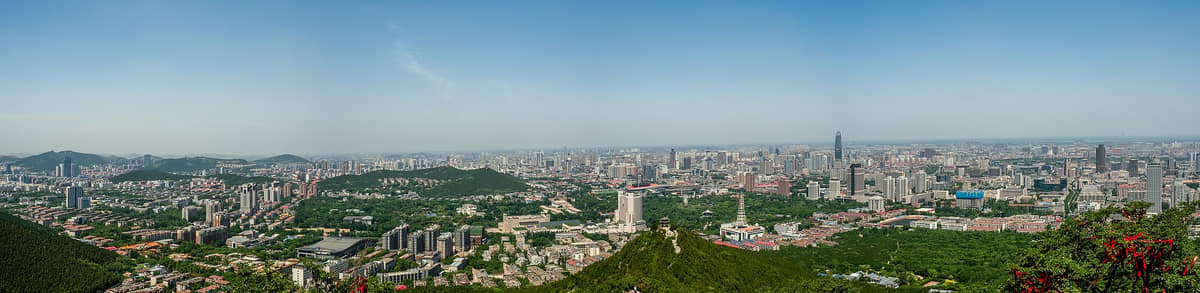
Jinan from Thousand Buddha MountainPhoto: Ermell · source · CC BY-SA 4.0
The historic core sits where groundwater emerges at the foot of southern limestone hills; the municipality extends north across the plain to the Yellow River and southeast into the Laiwu and Gangcheng areas.[1][2][3][4]
Karst groundwater, southern hills, spring-fed old city, Yellow River plain, and a geographically expanded twelve-unit municipality define Jinan.
Karst spring belt
Rainwater enters limestone in the southern hills, moves underground, and emerges where geology and elevation force groundwater toward the surface.[1][2][3][4]
Mountain–plain transition
Jinan occupies the foot of the Shandong uplands where steep southern terrain opens onto the North China Plain.[1][2][3][4]
Yellow River
The river crosses the northern municipality, where levees, flood management, sediment, farmland, bridges, and new districts shape development.[1][2][3][4]
Municipal scale
Ten districts and two counties span spring-fed old city, southern mountains, eastern growth corridors, former Laiwu and Gangcheng areas, Yellow River plain, and rural towns.[1][2][3][4]
Permanent residents across Jinan's ten districts and two counties; do not mix with the separately reported 7.435 million urban permanent residents, 8.288 million registered residents, visitors or metropolitan estimates
Population figures use the administrative area and source date shown below.[5][6]
Climate
Warm-temperate continental monsoon climate
Summers are hot and rainy, winters cold and dry, and spring can be windy; rainfall strongly affects groundwater recharge and spring flow.
Climate describes long-term seasonal patterns; live conditions appear separately.[1][2][3][4]
Seasonal patterns
March–May
Spring
Dry wind, fast warming, pollen, and variable groundwater conditions make layers and current spring-status information useful.[1][2][3][4]
June–August
Summer
Hot humid weather and concentrated rain recharge groundwater but also bring storms; use shade and avoid unsafe channels during heavy rain.[1][2][3][4]
September–November
Autumn
Clearer, drier weather often suits spring routes, Daming Lake, southern hills, museums, and longer city walks.[1][2][3][4]
December–February
Winter
Cold dry air, occasional snow, bare vegetation, and indoor heating define the season; stone and water routes can be slippery.[1][2][3][4]
A short history of the city
Eleven sourced layers move from Neolithic Chengziya and Bronze Age settlement through the historical Ji River name, medieval religious landscapes, the 1376 provincial capital, the Ming–Qing spring city, rail and institutional modernity, the neutral documentation of the 1928 conflict, reconstruction and today's twelve-unit municipality.
Jinan Municipal MuseumPhoto: Gary Todd from Xinzheng, China · source · CC0
Chengziya and the name Longshan culture
The archaeological discovery at Chengziya in 1928 helped give Longshan culture its scholarly name. The site, later excavations, museum displays and broad regional culture are related but not interchangeable; modern Jinan boundaries must not be projected onto every archaeological distribution.[7][13]
Daxinzhuang and changing settlement systems
Sites and museum collections around the municipality document settlement, craft, exchange and social hierarchy across later prehistoric and early historic periods. Object labels, excavation reports and provenance are stronger evidence than stylistic resemblance alone.[7][14]
A city south of the former Ji River
The municipal history explains the name Jinan through its position south of the historical Ji River. River courses, administrative names and urban centres changed, so etymology is a historical relationship rather than a map of today's waterways.[7][8]
Caves, temples and stone pagodas
Thousand Buddha Mountain, Four Gates Pagoda and Lingyan Temple preserve different layers of Buddhist patronage, carving, masonry, monastic life, repair and later visitation. No single foundation date can date every visible structure.[7][12]
Jinan as Shandong's provincial capital
Official history places Jinan's establishment as the provincial capital in 1376. Administrative institutions, walls, markets, water works and regional routes shaped the city, while the current metropolis extends far beyond the historical walled footprint.[7]
Water, gardens, streets and writing
Spring pools, channels, Daming Lake, temples, gardens and neighbourhoods accumulated inscriptions, poetry, local records and everyday routines. Literary fame is important evidence of reception, but it cannot prove that present structures survive unchanged from the period described.[7][11][9]
Railways, commerce, schools and new architecture
Rail connections, industrial and commercial facilities, schools, hospitals and religious buildings added new urban forms. Hongjialou Cathedral and Luokou bridge should be read within changing institutions and transport networks, not as isolated imported styles.[7][12]
Conflict, occupation and civilian experience
The 1928 Jinan Incident was a dated episode of armed conflict and occupation with serious civilian consequences. It should be documented through corroborated archives, distinguish participants and victims, and avoid turning suffering into nationalist spectacle or present-day political endorsement.[7][12]
War, reconstruction and provincial institutions
War and political change disrupted the city; later provincial administration, universities, factories, railways, hospitals, housing and museums expanded it. Institutional histories, building histories and personal memories require separate sources.[7][14]
Metropolitan growth and heritage reconstruction
Roads, housing, industry, universities, public squares and service sectors reshaped Jinan. Chaoran Tower's present form belongs to contemporary reconstruction within a much older literary and lake landscape, illustrating why memory and fabric must be labelled separately.[7][12]
Twelve county-level units and several urban scales
Today's municipality includes ten districts and two counties, with the former Laiwu area integrated into Jinan in 2019. End-2025 permanent residents totalled 9.616 million; old-city conservation, new districts, Yellow River infrastructure, county towns, farming and industrial communities change at different speeds.[6][5][7]
People, language, and everyday rhythms
Eight perspectives describe 9.616 million end-2025 permanent residents through statistical scope, twelve local contexts, spring-side life, education and migration, industrial labour, county food supply, language and an explicit rejection of one city personality.
Population with a defined scope
The 9.616 million figure is the official end-2025 permanent-resident count for the full municipality. The bulletin separately reports 7.435 million urban permanent residents and 8.288 million registered residents; these figures answer different questions and must not be mixed.[5][6][8][7]
Twelve local contexts
Ten districts and two counties include spring-side old neighbourhoods, newer eastern and western centres, northern Yellow River plains, southern uplands, Zhangqiu towns, Pingyin and Shanghe counties, and Laiwu–Gangcheng industrial and rural communities. Each unit also contains internal differences.[5][6][8][7]
Living with springs
Old-city water channels shape walking routes, sitting places, maintenance work, gardens, tourism and neighbourhood memory. Access to spring-side space is uneven, and a celebrated landscape still requires cleaning, monitoring, drainage and public management.[5][6][8][7]
Education, migration and commuting
Universities, provincial services, technology, health care and new employment draw students and workers, while county-to-city movement, intercity migration, return migration and commuting reshape households. One annual total cannot show residence duration, housing pressure or belonging.[5][6][8][7]
Industrial and logistics labour
Manufacturing, rail, road freight, warehousing, construction, energy and maintenance connect Jinan to regional production networks. Gangcheng, Laiwu and other industrial zones should not be reduced to background for a spring-city brand.[5][6][8][7]
County towns, farming and food supply
Grain, vegetables, fruit, livestock, roses, markets, processing and transport link rural areas to urban kitchens. Farming households, seasonal workers and county services are part of metropolitan life even when they are absent from postcard views.[5][6][8][7]
Language and local speech
Standard Mandarin is widely used, while Jinan speech belongs to broader Jilu Mandarin traditions and varies by district, county, generation and migration history. Accent is evidence of social geography, not a test of authentic identity.[5][6][8][7]
No single city personality
Labels such as hospitable, direct or leisurely may describe some encounters but cannot stand in for 9.616 million people. Age, occupation, income, disability, gender, neighbourhood, education and mobility produce many different Jinan experiences.[5][6][8][7]
Shandong MuseumPhoto: Gary Todd from Xinzheng, China · source · CC0
Spring culture as a managed system
Spring identity depends on geology, recharge areas, groundwater flow, monitoring, drainage, maintenance, public behaviour and seasonal rainfall. Culture is therefore inseparable from environmental management, not merely a set of poetic names.[9][10]
Water-street life
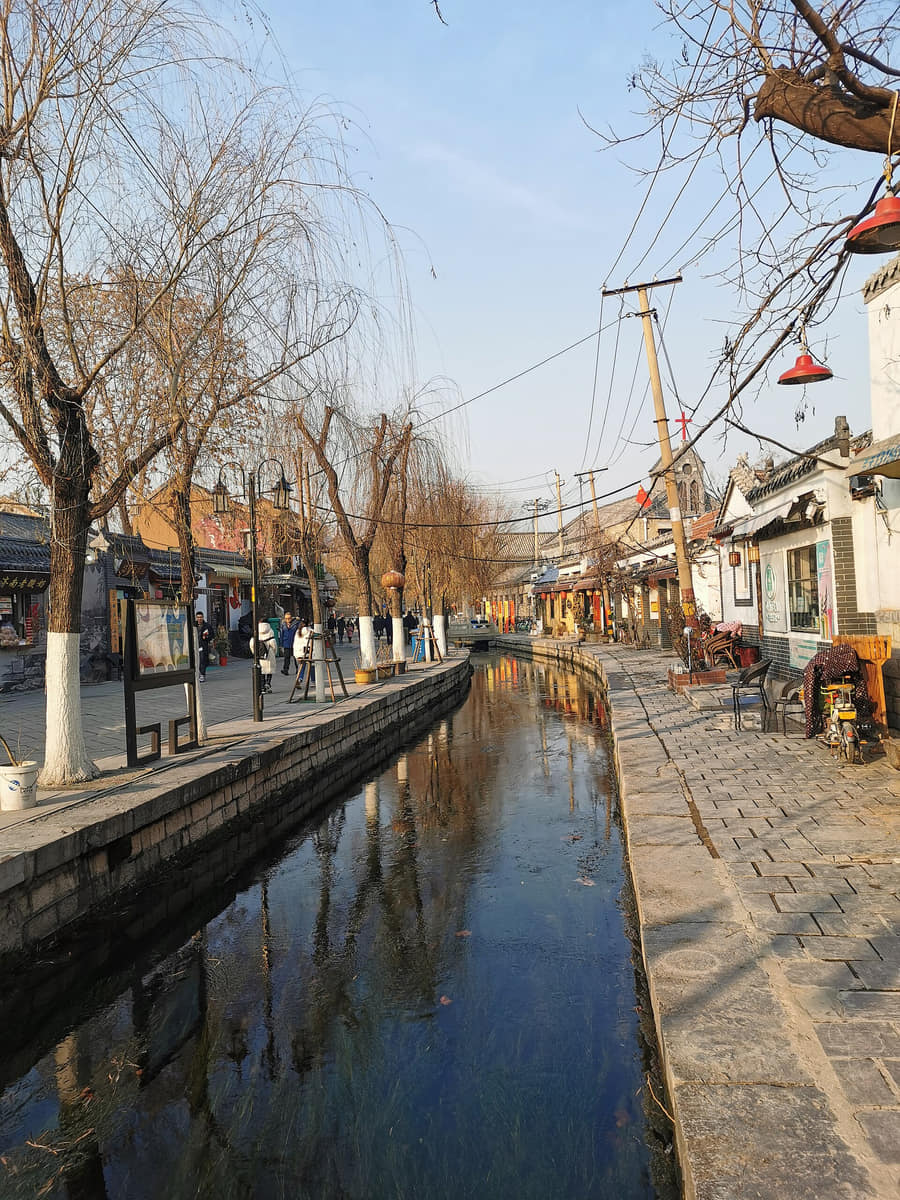
Qushuiting and Baihuazhou connect channels, courtyards, lanes, shops, willow trees and public sitting places. Conservation must balance historic spatial pattern, resident needs, commerce, tourism, disaster prevention and water management.[11][10]
Daming Lake as a literary landscape
Poetry, local writing, pavilions, islands, gardens and later popular culture have repeatedly reframed Daming Lake. Literary association enriches the place but does not date the present pavilion or prove unbroken physical continuity.[7][12]
Historic-district conservation
The official Furong Street–Baihuazhou plan defines an 8.5-hectare core and 17.2-hectare development-control area within a 25.7-hectare protected district. Those planning boundaries identify management layers, not a claim that every facade is ancient.[11]
Longshan archaeology
Chengziya made Jinan central to the history of Chinese archaeological classification. Contemporary interpretation should distinguish the type site, the wider archaeological culture, later research, museum objects and public branding.[7][13][14]
Buddhist architecture and practice
Lingyan Temple, Four Gates Pagoda and Thousand Buddha Mountain combine protected fabric, later repair, worship, tourism, landscape and scholarship. Living practice deserves respect, while architectural dates require building-level evidence.[12]
A living Catholic landmark
Hongjialou Cathedral is both architecture and a place of worship. A cultural guide should explain its urban and construction history without treating services, congregation or sacred interiors as tourist staging.[12]
Lü Opera
The national intangible-heritage record includes Jinan among several declaring localities for Lü Opera. Performance, accompaniment, repertoire, training and audience change across companies and places; it should not be presented as Jinan's exclusive invention.[16]
Jinan shadow puppetry
Cut figures, manipulation, voice, music, light and a small screen form a portable performance system. Heritage status describes safeguarding responsibility, not proof that every contemporary show follows one fixed historical form.[17]
Jiyang drum yangge
Large-group movement, percussion, roles, formations and village participation make Jiyang drum yangge a social as well as performative tradition. Festival schedules, teams and routes are current information.[18]
Craft and labour traditions
Clay rabbits, black pottery, food techniques and Yellow River ramming songs show how clay, firing, tools, construction labour, markets and apprenticeship enter cultural memory. Demonstrations, commercial products and inherited practice should be labelled separately.[19]
Museums and heritage status
Jinan's museums connect local material with provincial and regional histories. The Jinan Spring and City Cultural Landscape is on China's World Heritage Tentative List; tentative-list inclusion is a preparatory national status, not UNESCO World Heritage inscription.[14][15]
Food and local flavor
Fourteen entries explain oil whirl, savory tianmo, bazirou, jiuzhuan dachang, Yellow River carp, braised chicken, milk soup with cattail, stir-fried kidney, candied sweet potato, a dated restaurant dish, Pingyin rose cake, Laiwu sausage, wheat staples and safe menu reading through technique, variation, provenance, allergens and current food safety.
Image credits and licenses
Big-bowl tea near Five Dragon PoolPhoto: Steven Sun · source · CC BY-SA 4.0
Coiled dough, oil, seasoning, folding and heat create a crisp exterior and layered centre. The municipal heritage record documents a Jinan technique, but shape, filling, fat, size and baking method vary; check sesame, wheat and other allergens.[22][20]
Savory grain-and-vegetable breakfast
Tianmo
Despite the character for “sweet” in its name, tianmo is generally a savory, thick breakfast preparation built around grain and vegetables with many versions. Ask about peanuts, soy, gluten, sesame, spice and serving temperature.[24][26][20]
Braised meat meal
Bazirou with rice
Slow-braised pork is commonly served with rice and selectable sides such as egg, tofu products, meatballs or vegetables. Cut, sweetness, salt, sides and portion vary; the gallery shows one serving rather than a canonical plate.[23][25][20]
Layered sweet-sour-savory braise
Jiuzhuan dachang
Careful cleaning, preliminary cooking, frying or searing, braising and layered seasoning make this a technically demanding restaurant dish. Organ meat, sugar, salt, fat and strong aromatics may not suit every diner.[20][21]
Whole-fish restaurant dish
Sweet-and-sour Yellow River carp
The landmark-food listing links the dish to Yellow River carp, while any individual restaurant should verify actual species and sourcing. Deep frying and a sugar-vinegar sauce create contrasting texture; bones, oil and serving size matter.[20][21]
Pot-braised chicken meal
Braised chicken
Chicken pieces are braised with sauce and additions that vary by kitchen, then often served with rice. The widely distributed commercial form should not erase Jinan associations, yet no single chain recipe represents the entire tradition.[20][21]
Soup technique and aquatic vegetable
Milk soup with cattail heart
A pale, emulsified-style broth and tender cattail shoots connect kitchen technique with wetland and water-vegetable histories. “Milk soup” describes appearance and method in Shandong cooking and does not always mean dairy; ask the kitchen directly.[21][9]
Fast wok cooking and knife work
Stir-fried kidney
Cross-hatching increases surface area and creates a curled texture under fast, high heat. Cleaning, doneness and sauce balance are central; diners should ask about organ meat, alcohol, soy, gluten and spice.[21]
Hot sugar technique
Candied sweet potato
Fried or cooked sweet potato is coated in hot syrup so threads form as it is lifted and cools. Timing is part of the experience; hot sugar can burn, and sugar load, oil and shared-kitchen allergens matter.[21]
A dated Jinan restaurant example
Mianjin with braised ribs
The 2009 photograph shows wheat gluten absorbing braising sauce beside rib pieces. It is useful evidence of one served dish, not proof of a protected or uniquely Jinan recipe; wheat, soy and meat ingredients require checking.[21]
County ingredient and baked snack
Pingyin rose cake
The 2025 landmark-food list includes Pingyin rose flower cake, connecting a county rose-growing identity to pastry. Actual rose content, sugar, fat, wheat, nuts, shelf life and production origin vary by product.[20]
Cured meat from the expanded municipality
Laiwu sausage
Laiwu-area cured sausage adds a southeastern county-and-industry food story to contemporary Jinan. Meat cut, seasoning, casing, curing, producer, storage, nitrite controls and cooking instructions require product-level evidence.[21][6]
Buns, dumplings, noodles and flatbreads
Wheat staples
Wheat foods organise many breakfasts and family meals, but fillings, fermentation, shape and occasion vary across households, canteens, neighbourhoods and counties. A single “Shandong staple” label hides substantial diversity.[21][8]
Provenance, technique and dietary safety
How to read a Jinan menu
Separate named tradition from the dish actually served: confirm species or meat cut, ingredients, portion, price, allergens, alcohol, spice, oil, halal or vegetarian requirements and current hygiene information. Heritage status never guarantees food safety.[20][21]
Landmarks and architecture
Image credits and licenses
Jinan from Thousand Buddha MountainPhoto: Ermell · source · CC BY-SA 4.0
Four Gates PagodaPhoto: ScareCriterion12 · source · CC0
Yellow River from a railway crossingPhoto: Stang · source · CC BY 4.0
Baotu Spring
A major outlet in Jinan's karst spring system, presented through water, stone, gardens, inscriptions and management rather than as an isolated scenic pool. Current discharge and water quality require live evidence.[9][10]
Daming Lake
A spring-fed urban lake where channels, moats, islands, gardens, roads, recreation and flood processes meet. The broad water landscape also reveals the old city's relation to southern relief.[9][8]
Qushuiting Street
A protected water-street corridor where spring channels run beside lanes, homes and commerce. Read resident life, public space, conservation and tourism together, while distinguishing building ages.[11][10]
Baihuazhou
An old-city waterside node within the Furong Street–Baihuazhou historic district. Water, low buildings, paths, willow trees and managed public space show both continuity and intervention.[11]
Black Tiger Spring
A public spring outlet embedded in the old-city moat landscape and everyday water use. Do not infer drinking safety, flow or crowding from a photograph or reputation.[9][10]
Five Dragon Pool
A spring group and garden north-west of the central old city, useful for comparing water levels, planting, rock work and public use with other spring sites.[9][10]
Baimai Spring Park
A Zhangqiu spring landscape that prevents the guide from treating central Lixia District as the whole spring system. Flow, park access and conditions remain dynamic.[9][8]
Thousand Buddha Mountain
Southern relief, paths, vegetation, carved and religious landscapes, city views and recreation meet on the mountain. Different features have different dates and current management.[12][8]
Four Gates Pagoda
A compact stone pagoda in Licheng District whose masonry, form, later repairs and religious setting require building-level conservation evidence rather than a single unqualified date.[12]
Lingyan Temple
A Changqing mountain religious landscape of halls, pagodas, stupas, inscriptions, trees, worship, scholarship and tourism. Original, repaired and later fabric must be distinguished.[12]
Spring City Square
A contemporary civic space that converts spring identity into sculpture, fountains, paths, gathering and skyline orientation. Live events and operations change its use.[9][7]
Shandong Museum
A provincial museum whose collections place Jinan within much wider histories of Shandong archaeology, art, natural history and social life. Provenance prevents provincial objects from being mislabelled as local finds.[14]
Jinan Municipal Museum
A city institution for local archaeology, art, documents and history. Object label, excavation context, restoration and current display are separate evidence layers.[14][7]
Chengziya archaeological site
The type site associated with the scholarly naming of Longshan culture, now a conservation and interpretation landscape in Zhangqiu. Archaeology should lead public branding, not be flattened by it.[13][7]
Sacred Heart Cathedral of Jinan
A prominent twin-tower religious building and a living worship site. Construction history, repair, congregation, services, access and etiquette require distinct, respectful documentation.[12][7]
Yellow River and Luokou railway bridge
The broad river, engineered banks, floodplain and long rail crossing reveal a scale absent from spring-side imagery. Hydrology, flood control, rail operation and safety need current specialist sources.[8][7]
Chaoran Tower
The present illuminated tower is a contemporary reconstruction that renews an older literary and lake association. Label the current structure, earlier tower histories and literary memory separately.[7][12]
Ways to explore the city
Trace spring water first, then compare the southern recharge landscape and Yellow River corridor to understand the city at three linked scales.
Follow spring water
Baotu Spring → moat → Qushuiting Street → Daming Lake
Trace groundwater from named pools through everyday channels into the old-city lake system.[1][2][3][4]
Mountain to spring
Southern hills → Thousand Buddha Mountain → central springs
Connect limestone recharge terrain, religious landscape, city views, groundwater movement, and public water spaces.[1][2][3][4]
Two water scales
Spring city → Yellow River corridor
Compare intimate channels and pools with levees, sediment, farmland, bridges, flood risk, and northern metropolitan growth.[1][2][3][4]