Jinci, Shanxi Museum, the Fen River, Jin culture, noodles, vinegar, and industrial transformation[1][2][3][4]
Guide scope
The central basin city, 10 county-level units, Fen River corridor, mountain edges, and historic Jinyang landscapes[1][2][3][4]
Understand Taiyuan through basin, river, and reinvention
Taiyuan is a basin capital shaped by the Fen River, surrounding mountains and a long sequence of urban centers. Jinyang archaeology, Jinci's ritual landscape, Tianlongshan's rock-cut art, Ming and Qing institutions, railways, industrial expansion and contemporary districts belong to different periods and must be read as layers rather than one uninterrupted monument.
The current municipality has ten county-level units: six districts, three counties and one county-level city. The 2025 population survey reports 5,526,060 permanent residents, of whom 90.40 percent were classified as urban residents; this statistical city is much larger and more varied than the central built-up area.
China Weather describes a warm-temperate continental monsoon climate with dry, cold winters, concentrated summer rainfall and rapid spring and autumn transitions. Climate is a long-term pattern: a visitor still needs live forecasts, air-quality, heat, rainfall, flood, snow and mountain-road information for the exact district and date.
This guide treats historic fabric, repairs, reconstructions, living religious use, museum display, industrial interpretation, commercial food venues and dated street photography as different evidence. Every image caption states what is actually visible and what it cannot prove.
Fen River basin
River, plain, mountains, and settlement corridors explain the city's geography.
Jinyang memory
Ancient political history, later reconstruction, and surviving landscapes overlap.
Wheat and vinegar
Noodle skill and fermentation reveal technique beyond a list of famous dishes.
Industrial transition
Heavy industry remains visible while new services, culture, and riverfronts expand.
A visual record of the city
Twenty-seven locally hosted, rights-cleared images connect Jinci, Tianlongshan, temples, museums, education, rail, industry, the Fen River, county food and everyday streets. Every caption separates historic fabric, restoration, replica, museum model, regional reference, commercial interpretation, dated scene and live visitor information.
Image credits and licenses
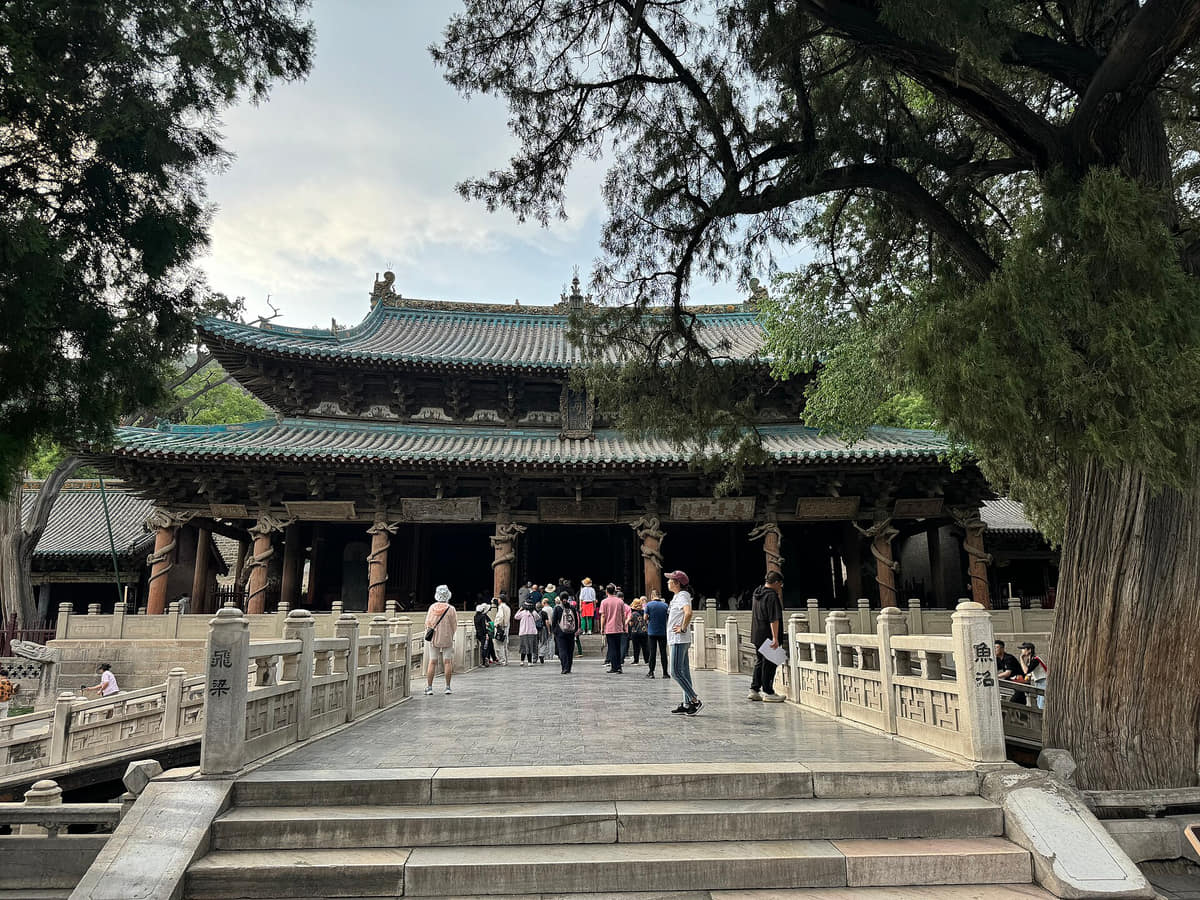
Saint Mother's Hall and Fish-Pond Flying Bridge at JinciPhoto: Patrick20242023 · source · CC BY-SA 4.0
Donghu Vinegar Experience Museum entrancePhoto: lienyuan lee · source · CC BY 3.0
Shanxi Wheaten Food Culture Museum exteriorPhoto: lienyuan lee · source · CC BY 3.0
Location, boundary, and 3D buildings
Taiyuan's built-up area follows the Fen River basin, while the municipality extends into mountain counties and the industrial city of Gujiao.[1][2][3][4]
Permanent residents across Taiyuan's ten county-level units
Population figures use the administrative area and source date shown below.[5]
Climate
Warm-temperate continental monsoon climate
The inland basin has hot, rainy summers, cold dry winters, strong sunshine, and large daily and seasonal temperature ranges.
Climate describes long-term seasonal patterns; live conditions appear separately.[1][2][3][4]
Seasonal patterns
March–May
Spring
Dry air, wind, and large temperature swings make flexible clothing useful; vegetation greens gradually in the basin.[1][2][3][4]
June–August
Summer
Warm to hot days and most annual rainfall support riverfront activity, while short heavy storms can interrupt plans.[1][2][3][4]
September–November
Autumn
Dry, clear weather and cooler evenings often suit architecture, museum, and mountain-edge exploration.[1][2][3][4]
December–February
Winter
Cold, dry conditions, heating, and basin inversions shape the season; exposed sites can be windy.[1][2][3][4]
A short history of the city
Eleven evidence-led layers move from Fen River basin archaeology and Jinyang through Tianlongshan, Tang memory, the 979 rupture, Ming institutions, vinegar and education, industrial expansion and today's ten-unit municipality.
Image credits and licenses
Saint Mother's Hall and Fish-Pond Flying Bridge at JinciPhoto: Patrick20242023 · source · CC BY-SA 4.0
Weathered carving at Tianlongshan Cave 10Photo: Patrick20242023 · source · CC BY-SA 4.0
Settlement, burial, craft and water-management evidence across the Fen River basin precedes the present city. Archaeology, later texts and local legends are different source types; the guide does not use an attractive origin story as proof of a precise founding date.[1][8]
Late Spring and Autumn foundations
Historical writing places Jinyang's formation in the late Spring and Autumn period, while archaeology tests the location, walls, buildings and changes of the site. The name, political center and physical city are related but not identical evidence.[1][8]
Regional center and route network
The basin linked northern routes, agricultural land and state administration through changing regimes. Administrative names and boundaries shifted, so modern Taiyuan should not be projected backward unchanged onto every ancient map.[1]
Buddhist patronage and Tianlongshan
Tianlongshan's caves were cut and expanded from the late Northern Wei and Eastern Wei through Northern Qi, Sui and Tang phases. Weathered surfaces, missing elements, later protection and digital restoration must be separated when interpreting the site.[10]
Jinyang and northern-capital associations
Jinyang retained major strategic and cultural importance, and Tang political memory remains visible in inscriptions, temples and later interpretation. Named associations should be tied to dated records rather than turned into claims that every surviving building is Tang fabric.[9][8]
Destruction, survival and a new center
Sources record the severe destruction of Jinyang during the Song conquest of Northern Han in 979. Later urban life shifted, but the archaeological site, ritual landscapes and settlements did not disappear from regional memory or material history.[8]
Walls, temples and institutions
The Ming period added and reshaped city walls, religious sites and administrative space. Chongshan Temple, the later Twin Pagodas and the old county-town landscape require structure-by-structure chronologies; a precinct can contain fabric from many dates.[8]
Markets, education, craft and vinegar
Temples, guild networks, shops, grain processing and vinegar workshops connected the walled city with Qingxu and other county economies. A heritage label records a craft tradition, not proof that every modern bottle follows the same method.[13][8]
Shanxi Daxuetang and new mobility
The establishment of Shanxi Daxuetang in the early twentieth century and railway construction added new institutional and transport geographies. Surviving gates, reused buildings and stations show later layers, while archives are needed to reconstruct classrooms, curricula and travel.[1][8]
Coal, steel, machinery and workers
Twentieth-century expansion made heavy industry, energy, machinery, housing and transport central to Taiyuan. Museums and facades can interpret this history, but they do not verify current production, emissions, safety, ownership or labor conditions.[1]
Ten units, river restoration and service growth
Today's six districts, three counties and Gujiao combine dense neighborhoods, universities, stations, factories, heritage sites, farms, mountain roads and the Fen River corridor. Conservation, climate adaptation and public access work at different scales across the legal municipality.[5][6][1]
People, language, and everyday rhythms
Eight perspectives describe 5.52606 million permanent residents through statistical scope, language, basin mobility, industry, education, county life, heritage labor and environmental change—without assigning one personality to everyone.
Population and statistical scope
The end-2025 permanent-resident figure is 5,526,060. The survey classifies 4,995,526 people, or 90.40 percent, as urban residents; these are statistical categories for the whole municipality, not a claim that daily life is uniform.[5][6][1][7]
Language without stereotype
Standard Mandarin is widely used, while Jin Chinese and neighborhood or county speech remain part of family, market and performance life. Accent does not reliably reveal origin, education, occupation, class or personality.[5][6][1][7]
Basin mobility
Rail, buses, roads, walking and cycling connect a north–south urban corridor, while mountain and county trips take different time and planning. A station photograph cannot predict today's fare, crowding, transfer or accessible route.[5][6][1][7]
Industrial working lives
Energy, steel, machinery, construction, logistics and environmental transition have shaped generations of work. A museum model explains systems but does not represent any worker's current shift, risk, wage or workplace.[5][6][1][7]
Education, health and services
Universities, hospitals, government, retail, culture, tourism, technology and transport create varied student and service-sector routines. Institutional numbers and exteriors should be dated and never substituted for access or quality measures.[5][6][1][7]
County and rural life
Qingxu, Yangqu, Loufan and Gujiao contain farms, towns, resource industries, reservoirs, mountain settlements and food-processing networks. County identity is not a costume: land, income, aging, services and household strategies vary.[5][6][1][7]
Heritage and visitor labor
Conservators, custodians, religious communities, guides, museum staff, vendors, cleaners, gardeners, drivers and craftspeople sustain the places visitors see. Images of quiet halls and landscapes often hide this work.[5][6][1][7]
Changing households and environments
Migration, aging, housing, heat, summer rain, winter cold, air conditions and digital access differ across ten units and over time. No single label—ancient capital, coal city, noodle city or tourist destination—describes every resident.[5][6][1][7]
Historic hall at Chongshan TemplePhoto: xiquinhosilva · source · CC BY 2.0
Twin Pagodas of Yongzuo Temple in 2011Photo: Roland Longbow · source · CC BY-SA 3.0
Enlarged replica of the Jin侯 bird-shaped zunPhoto: Roland Longbow · source · CC BY-SA 3.0
Jinci as an architectural landscape
Halls, bridges, springs, trees, sculpture, inscriptions and visitor routes form a layered ritual landscape. Each element has its own date and conservation history; the whole complex is not one-period architecture.[9]
Painted sculpture and viewing
Jinci's maid sculptures are read through pose, clothing, expression, spatial arrangement and conservation. Museum lighting and photography alter color, while a barrier reminds visitors that close access is controlled.[9]
Tianlongshan material evidence
Rock-cut caves record Northern Dynasties through Tang artistic phases together with weathering, removal, loss, return and digital reconstruction. Original stone, returned objects, replicas and digital images are distinct evidence.[10]
Twin Pagodas and urban silhouette
The paired brick towers at Yongzuo Temple remain a recognizable east-side silhouette. Symbolic visibility does not replace a building survey, current structural report or understanding of the living temple precinct.[8]
Chongshan Temple
Painted halls, stelae, courtyards and living religious use overlap. Architecture, collections, rituals, repairs and visitor etiquette should be described separately rather than collapsed into a generic 'ancient temple'.[8]
Chunyang Palace and museum reuse
A historic religious complex now also presents itself through an art-museum institution. Reuse can preserve and reinterpret buildings, but entrance signs do not tell the full story of collections, worship, management or interior fabric.[8]
Confucian and educational sites
Taiyuan's Confucian Temple, Shanxi Daxuetang site and later schools reveal changing ideas of ritual, examination, curriculum and public education. A carved stone or gate is one fragment, not the whole institution.[8]
Shanxi Museum and object literacy
The provincial museum connects Taiyuan to archaeology and material culture across Shanxi. The outdoor bird-zun image in this gallery is explicitly an enlarged replica; original objects, replicas, display labels and excavation context must not be confused.[3]
Jin opera
The nationally recorded opera tradition depends on vocal style, percussion, costume, repertoire, troupes, teachers, venues and audiences. A performance is a living interpretation, not direct proof of the historical event depicted on stage.[11]
Taiyuan gongs and drums
The nationally recorded percussion tradition links ensemble discipline, rhythm, movement, procession and celebration. Festival staging is one context among many and should not be used to claim an unchanged form across all communities.[12]
Industrial and railway memory
Stations, factories, mines, worker neighborhoods, technical schools, archives and museums explain modern Taiyuan. Adaptive reuse and exhibition can preserve memory while changing ownership, labor and social meaning.[1]
Contemporary public culture
Museums, libraries, parks, universities, theatres, sports venues, food streets and neighborhood spaces create newer layers. Programs, prices, accessibility and crowding change, so live institutional information remains essential.[1][5]
Food and local flavor
Fourteen entries move from wheat systems and tounao to wok technique, coarse grains, Qingxu vinegar, county foods, old brands, allergens, traceability, labor and live food-safety checks.
Image credits and licenses
Tounao with pickled chives and bunsPhoto: N509FZ · source · CC BY-SA 4.0
Donghu Vinegar Experience Museum entrancePhoto: lienyuan lee · source · CC BY 3.0
Shanxi Wheaten Food Culture Museum exteriorPhoto: lienyuan lee · source · CC BY 3.0
Staple and labor
Wheat as a food system
Noodles, breads, dumplings and batter-coated vegetables connect grain, milling, water, dough skill, fuel, kitchens, markets and household time. 'Many noodles' is not a complete description of who grows, makes and serves them.[14]
Cutting technique
Knife-cut noodles
Dough is cut directly into boiling water with practiced wrist and blade control, then paired with different broths, sauces and toppings. The gallery image is a low-resolution regional reference, not a universal Taiyuan bowl.[14]
One breakfast tradition
Tounao
The photographed serving combines a pale, thickened soup with meat pieces, pickled chives and steamed buns. Recipes may use mutton and other ingredients, but exact composition, alcohol, dairy, seasoning and portion must be checked with the shop.[14]
Contrast and variation
Pickled chives and accompaniments
A small salty or pungent side can cut through a rich soup, while buns make the meal more substantial. Pairings are service traditions, not mandatory rules; ask about salt, spice and substitutions.[14]
Wok technique
Guoyou rou
This official travel guide lists the dish among Taiyuan recommendations. Meat is briefly passed through oil and finished with vegetables and seasoning in many versions; cut, coating, oil, sauce and accompaniments vary by kitchen.[14]
Beyond refined wheat
Oat and coarse-grain noodles
Oats, millet, sorghum, buckwheat and other grains broaden the staple system. Forms such as rolled or basket-like oat noodles require technique, but grain identity does not guarantee gluten-free preparation or separate utensils.[14]
Vegetable and batter
Qingxu zhanpianzi
Vegetables are coated with a flour mixture and cooked, then eaten with sauces in varied household and restaurant versions. The photographed plate is one presentation; vegetable choice, thickness and dipping sauce are not fixed.[14]
County craft and trade
Qingxu mature vinegar
The national ICH record identifies Qingxu as a major production area and describes grain-based solid fermentation. Place, brand, age statement and dark color alone do not verify that a bottle follows the protected process.[13]
Process rather than slogan
Brewing stages
Grain preparation, saccharification or starter work, alcoholic fermentation, acetic fermentation, heating or smoking, filtration and aging form a chain of decisions. Factory practice, microbes, time and quality control differ; visitor venues are interpretation, not audits.[13]
Filled dough
Dumplings, buns and shaomai
Dough thickness, folds, fillings and cooking methods create many everyday and festive versions. Meat, egg, seafood, sesame, soy and shared steamers or utensils require direct questions for dietary needs.[14]
A wider municipality
Seasonal and county foods
Mengfeng cakes, Jinci osmanthus yuanxiao, Taiyuan da-lu noodles and other officially recommended foods connect neighborhoods and counties. A recommendation list identifies names, not one settled origin story, recipe or shop.[14]
Institutions and change
Old brands and food streets
Vinegar stores, breakfast shops, guild-hall restaurants and food streets preserve and market traditions through labor, procurement and service. Reputation does not replace current price, hygiene, opening, accessibility or employment checks.[14][13]
Ask precisely
Allergens and dietary requirements
Wheat, oats, soy, sesame, peanuts, egg, dairy, alcohol, meat stock and shared oil may appear. Vegetarian, vegan, halal, gluten and allergy needs require questions about ingredients, stock, utensils and cross-contact.[14][13]
Current checks
Traceability, labor and live safety
Photography cannot verify sourcing, kitchen temperature, oil reuse, wages, licenses, fermentation control or food safety. Check labels, storage, current notices, busy service conditions and your own health needs before ordering.[14][13]
Landmarks and architecture
Image credits and licenses
Saint Mother's Hall and Fish-Pond Flying Bridge at JinciPhoto: Patrick20242023 · source · CC BY-SA 4.0
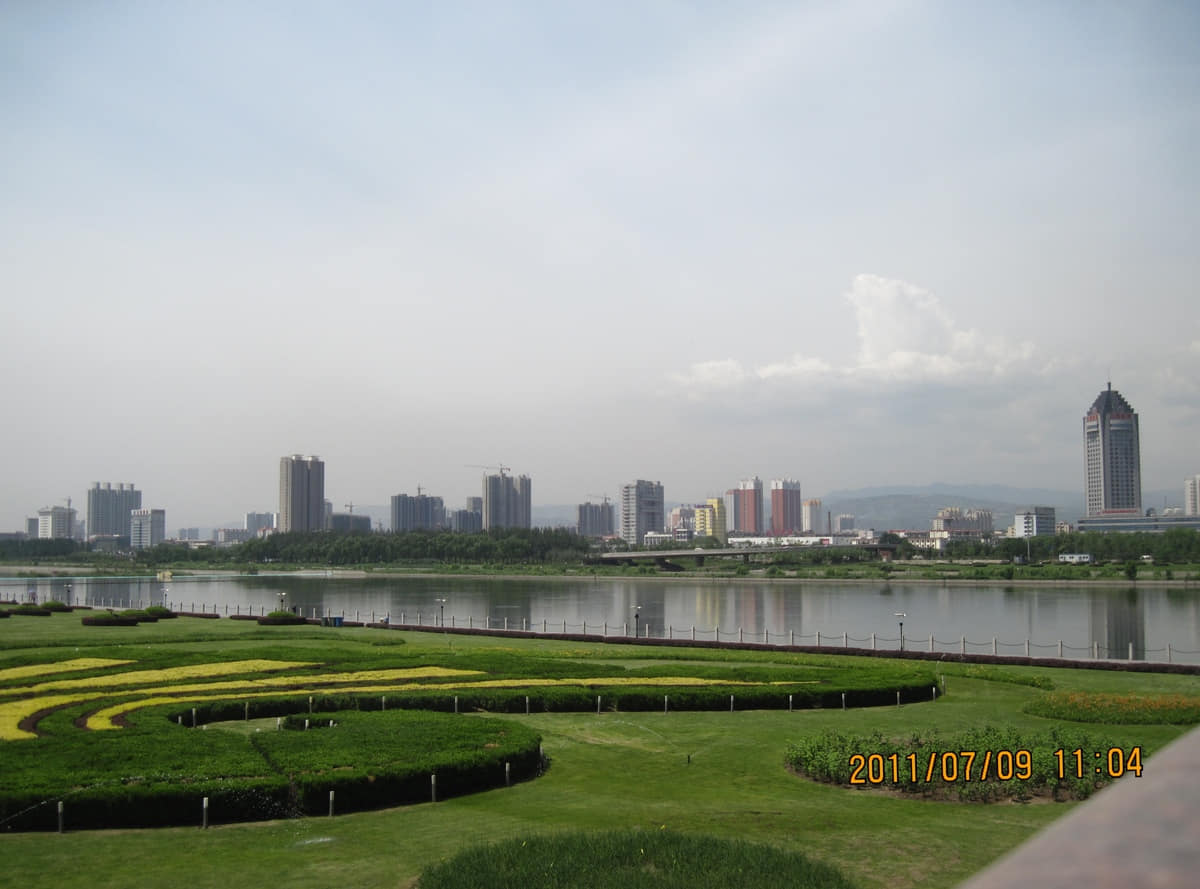
Fen River landscape in 2011Photo: Roland Longbow · source · CC BY-SA 3.0
Twin Pagodas of Yongzuo Temple in 2011Photo: Roland Longbow · source · CC BY-SA 3.0
Manshan Pavilion at TianlongshanPhoto: Underbar dk · source · CC BY-SA 4.0
Shanxi Museum exterior in 2011Photo: Roland Longbow · source · CC BY-SA 3.0
Jinci — Saint Mother's Hall and Fish-Pond Flying Bridge
A major architectural and ritual ensemble whose halls, bridge, sculpture, trees, springs and inscriptions span different dates. Historic fabric, repair and visitor infrastructure must remain distinct.[9]
Tianlongshan Grottoes
Rock-cut caves with Northern Dynasties through Tang phases, later losses, surviving stone, returned objects and digital interpretation. Check current mountain access and protection rules.[10]
Yongzuo Temple Twin Pagodas
A paired brick-tower landmark in a wider temple precinct. Exterior silhouette does not establish interior access, structural condition or the date of every repaired surface.[8]
Shanxi Museum
The provincial museum is essential for reading Shanxi archaeology and material culture from Taiyuan. Use collection records for objects and live institutional information for exhibitions and access.[3]
Taiyuan Railway Station
A contemporary passenger gateway whose 2025 exterior documents urban mobility. Timetables, security, transfers, crowding and accessibility are live operational information.[1]
Fen River corridor
A north–south water, landscape and public-space system involving flood control, habitat, bridges and recreation. Conditions vary by reach, season and date.[1][7]
Mengshan Giant Buddha landscape
A mountain site combining historic rock-cut remains, major modern restoration or completion and visitor infrastructure. These layers should never be presented as one untouched ancient object.[8]
Chongshan Temple
A living religious site with historic halls, painted decoration, stelae and current furnishings. Architecture, ritual, collections, repair and etiquette require separate information.[8]
Chunyang Palace and Shanxi Art Museum
A historic religious complex with contemporary museum use visible at the entrance. Current exhibitions, worship, management and interior access need live verification.[8]
Taiyuan Confucian Temple
A historic educational and ritual site read through courts, buildings and stone details. The photographed carving is one fragment, not a complete survey.[8]
Former Shanxi Daxuetang site
An education-heritage site whose surviving and reused buildings link early modern institutions with later schools. Exterior signs do not define the full historic campus.[8]
Coal Museum of China
An institution interpreting geology, mining technology, energy and safety. Models and displays are educational representations, not evidence of conditions in a working mine.[1]
Liuxiang commercial district
A central retail and pedestrian environment whose businesses, traffic and public life change. Dated street photography should not be sold as current visitor information.[1]
Qingxu vinegar landscape
Workshops, factories, shops and interpretation venues connect a county craft with modern production and tourism. Heritage status does not certify every product or health claim.[13][14]
Fen River wetland and mountain edge
A changing ecological landscape involving water, reeds, infrastructure and distant terrain. Use current environmental and access data rather than a small 2010 sunset image.[1][7]
Bingzhou Hotel
A visible twentieth-century and contemporary hospitality landmark with a distinctive street facade. Current ownership, rooms, service, heritage fabric and booking require separate checks.[1]
Jinyang archaeological and old-county landscape
Archaeological remains and the restored old-county visitor area occupy related but different historical landscapes. Excavated evidence, reconstruction and commercial programming must be labelled separately.[8]
Ways to explore the city
Combine one historic landscape, one museum, and the Fen River to connect Taiyuan's long history with its contemporary transformation.
Museum to river
Shanxi Museum → Fen River Park
Move from provincial material history to the contemporary water corridor shaping the capital.[1][2][3][4]
Jinyang landscape
Jinci → Ancient County → southwestern hills
Connect springs, ritual architecture, old urban plans, and the basin's mountain edge.[1][2][3][4]
Industry and renewal
Industrial district → neighborhood meal → riverfront
Observe how factory memory, work, food, housing, and public-space renewal coexist.[1][2][3][4]