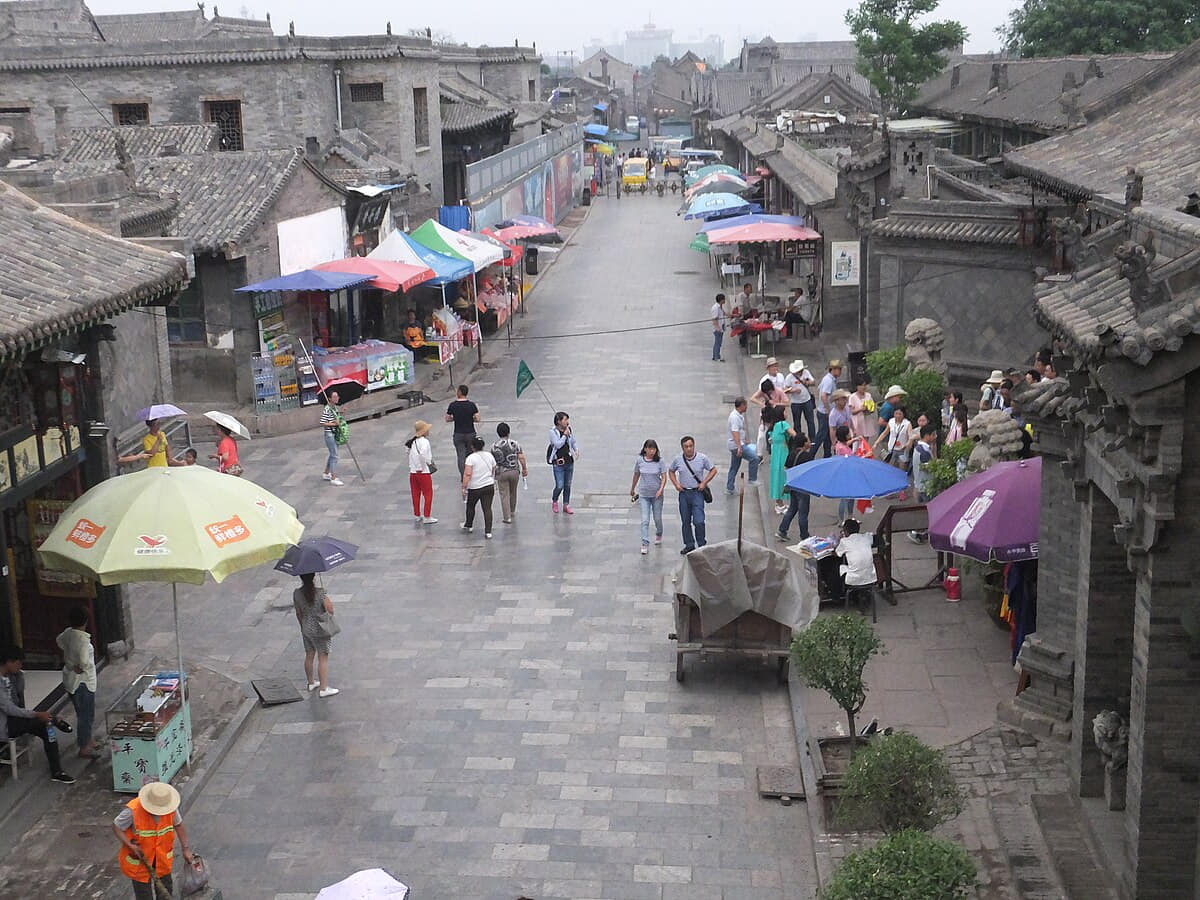
Jinzhong is a basin-and-mountain region where Pingyao, merchant compounds, lacquer and temple art, county markets, farming, mining history, and contemporary Taiyuan-region growth intersect.
11 county-level units with reviewed boundaries[1][2][3][4]
Read Jinzhong as a complete municipality
Jinzhong is a basin-and-mountain region where Pingyao, merchant compounds, lacquer and temple art, county markets, farming, mining history, and contemporary Taiyuan-region growth intersect.
Jinzhong Basin, Fen River tributary plains, Taihang mountain counties, Historic county towns and courtyard villages explain why the municipality cannot be reduced to its best-known landmark.
Pingyao walled-city conservation, Merchant-family archives and compounds, Pingyao lacquerware, Shuanglin Temple sculpture conservation, Qi County yangge performance, Mianshan temple and mountain routes are documented as distinct practices carried by particular institutions and communities, not as traits shared by every resident.
This profile separates dated population, long-term climate, live weather, historical evidence, current access, and editorial interpretation. District and county conditions require local checks.
Land and water
Land and water, Historical layers, and Living culture and work form a connected spatial system in Jinzhong. Reading them together keeps the central city, outer districts, county seats, villages, water, and terrain at their proper scales.
Historical layers
Historical layers, Living culture and work, and County-level differences form a connected spatial system in Jinzhong. Reading them together keeps the central city, outer districts, county seats, villages, water, and terrain at their proper scales.
Living culture and work
Living culture and work, County-level differences, and Land and water form a connected spatial system in Jinzhong. Reading them together keeps the central city, outer districts, county seats, villages, water, and terrain at their proper scales.
County-level differences
County-level differences, Land and water, and Historical layers form a connected spatial system in Jinzhong. Reading them together keeps the central city, outer districts, county seats, villages, water, and terrain at their proper scales.
A visual record of the city
Six reviewed visual records for Jinzhong.
Image credits and licenses
Pingyao Ancient CityPhoto: lienyuan lee · source · CC BY 3.0
Jinzhong Basin, Fen River tributary plains, and Taihang mountain counties form a connected spatial system in Jinzhong. Reading them together keeps the central city, outer districts, county seats, villages, water, and terrain at their proper scales.[1][2][3][4]
Fen River tributary plains
Fen River tributary plains, Taihang mountain counties, and Historic county towns and courtyard villages form a connected spatial system in Jinzhong. Reading them together keeps the central city, outer districts, county seats, villages, water, and terrain at their proper scales.[1][2][3][4]
Taihang mountain counties
Taihang mountain counties, Historic county towns and courtyard villages, and Jinzhong Basin form a connected spatial system in Jinzhong. Reading them together keeps the central city, outer districts, county seats, villages, water, and terrain at their proper scales.[1][2][3][4]
Historic county towns and courtyard villages
Historic county towns and courtyard villages, Jinzhong Basin, and Fen River tributary plains form a connected spatial system in Jinzhong. Reading them together keeps the central city, outer districts, county seats, villages, water, and terrain at their proper scales.[1][2][3][4]
Population figures use the administrative area and source date shown below.[1][2][3][4]
Climate
Temperate continental monsoon climate
The Jinzhong Basin has hot summers, cold dry winters, and concentrated summer rain; the Taihang and Lüliang-facing counties add elevation, wind, and rapid temperature changes.
Climate describes long-term seasonal patterns; live conditions appear separately.[1][2][3][4]
Seasonal patterns
March–May
Spring
Spring conditions in Jinzhong can change quickly. Check rain, wind, fog, pollen, temperature, elevation, and coastal or mountain exposure for the exact route.[1][2][3][4]
June–August
Summer
The Jinzhong Basin has hot summers, cold dry winters, and concentrated summer rain; the Taihang and Lüliang-facing counties add elevation, wind, and rapid temperature changes.[1][2][3][4]
September–November
Autumn
Autumn often brings cooler evenings and clearer intervals, but river, coast, mountain, desert, grassland, and county conditions still require a current forecast.[1][2][3][4]
December–February
Winter
Winter varies across Jinzhong's municipality. Check cold, wind, ice, snow, fog, heating, road, and elevation conditions rather than applying one city-center forecast everywhere.[1][2][3][4]
A short history of the city
Five dated layers connect material evidence with present urban and county form.
Basin agriculture and route formation
Basin agriculture and route formation belongs to Jinzhong's longer sequence from Basin agriculture and route formation to Heritage stewardship and regional urbanization. Archaeology, surviving sites, collections, routes, maps, and current urban form provide different evidence and should not be collapsed into one narrative.[1][2][3][4]
County towns, temples, and market networks
County towns, temples, and market networks belongs to Jinzhong's longer sequence from Basin agriculture and route formation to Heritage stewardship and regional urbanization. Archaeology, surviving sites, collections, routes, maps, and current urban form provide different evidence and should not be collapsed into one narrative.[1][2][3][4]
Merchant finance and courtyard compounds
Merchant finance and courtyard compounds belongs to Jinzhong's longer sequence from Basin agriculture and route formation to Heritage stewardship and regional urbanization. Archaeology, surviving sites, collections, routes, maps, and current urban form provide different evidence and should not be collapsed into one narrative.[1][2][3][4]
Rail, mining, industry, and institutional change
Rail, mining, industry, and institutional change belongs to Jinzhong's longer sequence from Basin agriculture and route formation to Heritage stewardship and regional urbanization. Archaeology, surviving sites, collections, routes, maps, and current urban form provide different evidence and should not be collapsed into one narrative.[1][2][3][4]
Heritage stewardship and regional urbanization
Heritage stewardship and regional urbanization belongs to Jinzhong's longer sequence from Basin agriculture and route formation to Heritage stewardship and regional urbanization. Archaeology, surviving sites, collections, routes, maps, and current urban form provide different evidence and should not be collapsed into one narrative.[1][2][3][4]
People, language, and everyday rhythms
Residents are described through language, work, mobility, neighborhood, and present choice—not fixed personality labels.
Jinzhong local speech and Standard Mandarin
Language use varies by household, generation, neighborhood, school, workplace, county, and migration history. Speech cannot be used as a fixed identity label.[1][2][3][4]
Urban cores, county seats, towns, and villages
Jinzhong's communities differ in density, services, transport, work, land use, and daily schedules across the municipality.[1][2][3][4]
Work, study, migration, and family networks
Residents connect Jinzhong to other places through employment, study, trade, care, migration, and tourism, continually changing local communities.[1][2][3][4]
Community-specific and changing identities
Age, occupation, language, gender, neighborhood, county background, and personal choice produce varied experiences; no single personality represents Jinzhong.[1][2][3][4]
Culture and daily life
Pingyao walled-city conservation
Pingyao walled-city conservation is presented through named places, practitioners, institutions, materials, work, and community choices. Its relationship with Merchant-family archives and compounds and Pingyao lacquerware shows a living, changing practice rather than a fixed citywide identity.[1][2][3][4]
Merchant-family archives and compounds
Merchant-family archives and compounds is presented through named places, practitioners, institutions, materials, work, and community choices. Its relationship with Pingyao lacquerware and Shuanglin Temple sculpture conservation shows a living, changing practice rather than a fixed citywide identity.[1][2][3][4]
Pingyao lacquerware
Pingyao lacquerware is presented through named places, practitioners, institutions, materials, work, and community choices. Its relationship with Shuanglin Temple sculpture conservation and Qi County yangge performance shows a living, changing practice rather than a fixed citywide identity.[1][2][3][4]
Shuanglin Temple sculpture conservation
Shuanglin Temple sculpture conservation is presented through named places, practitioners, institutions, materials, work, and community choices. Its relationship with Qi County yangge performance and Mianshan temple and mountain routes shows a living, changing practice rather than a fixed citywide identity.[1][2][3][4]
Qi County yangge performance
Qi County yangge performance is presented through named places, practitioners, institutions, materials, work, and community choices. Its relationship with Mianshan temple and mountain routes and Pingyao walled-city conservation shows a living, changing practice rather than a fixed citywide identity.[1][2][3][4]
Mianshan temple and mountain routes
Mianshan temple and mountain routes is presented through named places, practitioners, institutions, materials, work, and community choices. Its relationship with Pingyao walled-city conservation and Merchant-family archives and compounds shows a living, changing practice rather than a fixed citywide identity.[1][2][3][4]
Food and local flavor
Six locally named food records connect ingredients, technique, work, markets, and social settings.
Pingyao beef is one locally named food record. Ingredients, technique, season, maker, serving context, and district or county provenance should be checked separately rather than inferred from the name alone.
Taigu cake is one locally named food record. Ingredients, technique, season, maker, serving context, and district or county provenance should be checked separately rather than inferred from the name alone.
Yuci guanchang is one locally named food record. Ingredients, technique, season, maker, serving context, and district or county provenance should be checked separately rather than inferred from the name alone.
Oat noodles is one locally named food record. Ingredients, technique, season, maker, serving context, and district or county provenance should be checked separately rather than inferred from the name alone.
Wan-tuo buckwheat noodles is one locally named food record. Ingredients, technique, season, maker, serving context, and district or county provenance should be checked separately rather than inferred from the name alone.
Millet dishes is one locally named food record. Ingredients, technique, season, maker, serving context, and district or county provenance should be checked separately rather than inferred from the name alone.
Pingyao Ancient City is a physical entry point into Jinzhong. Surviving fabric, date, use, conservation, current access, and its relationship with Qiao Family Compound remain separate questions.[1][2][3][4]
Qiao Family Compound
Qiao Family Compound is a physical entry point into Jinzhong. Surviving fabric, date, use, conservation, current access, and its relationship with Shuanglin Temple remain separate questions.[1][2][3][4]
Shuanglin Temple
Shuanglin Temple is a physical entry point into Jinzhong. Surviving fabric, date, use, conservation, current access, and its relationship with Mianshan landscape remain separate questions.[1][2][3][4]
Mianshan landscape
Mianshan landscape is a physical entry point into Jinzhong. Surviving fabric, date, use, conservation, current access, and its relationship with Chang Family Compound remain separate questions.[1][2][3][4]
Chang Family Compound
Chang Family Compound is a physical entry point into Jinzhong. Surviving fabric, date, use, conservation, current access, and its relationship with Jinzhong courtyard architecture remain separate questions.[1][2][3][4]
Jinzhong courtyard architecture
Jinzhong courtyard architecture is a physical entry point into Jinzhong. Surviving fabric, date, use, conservation, current access, and its relationship with Pingyao Ancient City remain separate questions.[1][2][3][4]
Ways to explore the city
Three field sequences connect the urban core with contrasting district or county landscapes.
Field route
Yuci Old City → Chang Family Compound → basin villages
Yuci Old City → Chang Family Compound → basin villages is route 1 for comparing Jinzhong's built form, landscape, work, and district or county context. Verify live weather, transport, opening, safety, and conservation rules before departure.[1][2][3][4]
Field route
Pingyao walls → county yamen → Shuanglin Temple
Pingyao walls → county yamen → Shuanglin Temple is route 2 for comparing Jinzhong's built form, landscape, work, and district or county context. Verify live weather, transport, opening, safety, and conservation rules before departure.[1][2][3][4]
Field route
Qiao Family Compound → Taigu old town → Mianshan
Qiao Family Compound → Taigu old town → Mianshan is route 3 for comparing Jinzhong's built form, landscape, work, and district or county context. Verify live weather, transport, opening, safety, and conservation rules before departure.[1][2][3][4]
Sources and review
Last content update
Image verificationImage rights and place accuracy are approved.
Map verificationMap license, version, and administrative code are verified.